

01
The seven-day route at a glance
This plan counts arrival as Day 1 and departure as Day 7. It suits a first visit focused on architecture, markets and city walks, with daytime trains between cities. Day 1 assumes you have at least part of the afternoon free. A late arrival changes the first day's sightseeing, not the six-night total.
The compromise is Bukhara: two nights give you an arrival afternoon and one full day, rather than a slow three-day visit. We preserve those two nights and the final night in Tashkent instead of adding another city.
| Day | Main plan | Travel allowance | Sleep |
|---|---|---|---|
| 1 | Arrive in Tashkent; Chorsu or Hazrat Imam if time permits | Arrival, transfer and rest | Tashkent · night 1 |
| 2 | Train to Samarkand; Registan and Gur-e Amir | Keep the first half of the day flexible | Samarkand · night 2 |
| 3 | Shah-i-Zinda, Bibi-Khanym and Siyob; one optional museum | No intercity travel | Samarkand · night 3 |
| 4 | Train to Bukhara; Lyabi Hauz and trading domes | Keep half a day for the move | Bukhara · night 4 |
| 5 | Samanid Mausoleum, Bolo Hauz, Ark and Poi Kalon | Full sightseeing day | Bukhara · night 5 |
| 6 | Return to Tashkent; an easy evening | Give the return journey most of the day | Tashkent · night 6 |
| 7 | Depart from Tashkent | Airport transfer and airline check-in | No included overnight |
02
Why leave Khiva out of a one-week itinerary?
With return flights through Tashkent, Khiva adds a fourth city to a schedule that already has three train journeys. Keeping all four would mean another hotel change and less time in Samarkand or Bukhara, or using an overnight journey as part of the route. Our choice is to protect the full sightseeing days.
If Khiva is the main reason for your trip, build the week around it and remove another city. Check an arrival or departure through Urgench, then arrange the rest around flights and trains that actually operate on your dates. For a route including all four cities, start with the 10-day Uzbekistan itinerary.
03
Day 1: settle into Tashkent, then choose one area
After arriving, get to your accommodation and decide how much time you have after food and rest. If it is already late, keep the day to dinner and preparing for tomorrow's train. Avoid scheduling the visit you most want to make on arrival day.
With a usable afternoon, choose Chorsu for a market walk. The official Uzbek tourism guide places it in the old city, near Kukeldash Madrasah and Khoja Ahrar Vali Mosque, and describes stalls for dried fruit, nuts, spices and bread, plus places serving prepared food. Look at quantities and prices before buying; make lunch or a snack part of the visit. Uzbekistan Travel: Chorsu
Alternatively, visit Hazrat Imam, also called Khast Imam. Barak Khan Madrasah and the Kaffal Shashi Mausoleum are among the buildings in this religious ensemble. Choose this area if religious architecture interests you more than shopping. Check access to individual interiors on arrival; the square and a museum visit are different commitments. Uzbekistan Travel: Hazrat Imam
For the first hotel, compare the actual airport-to-hotel and hotel-to-station journeys. Confirm whether you can leave luggage before check-in. Reserve any required early check-in explicitly.
04
Day 2: travel to Samarkand and give Registan time
Book the Tashkent–Samarkand journey first, then fit the sightseeing around its arrival time. Our Tashkent to Samarkand train guide explains the station and arrival decisions. Keep the morning flexible for checkout, the station and reaching your Samarkand accommodation.
Make Registan the main visit. Its three madrasahs are Ulugh Beg, Sher-Dor and Tilya-Kori; seeing their courtyards and interiors takes longer than taking a photograph outside the square. We suggest leaving a substantial afternoon block for the ensemble, rather than assigning a quick stop between several attractions. Uzbekistan Travel: Registan
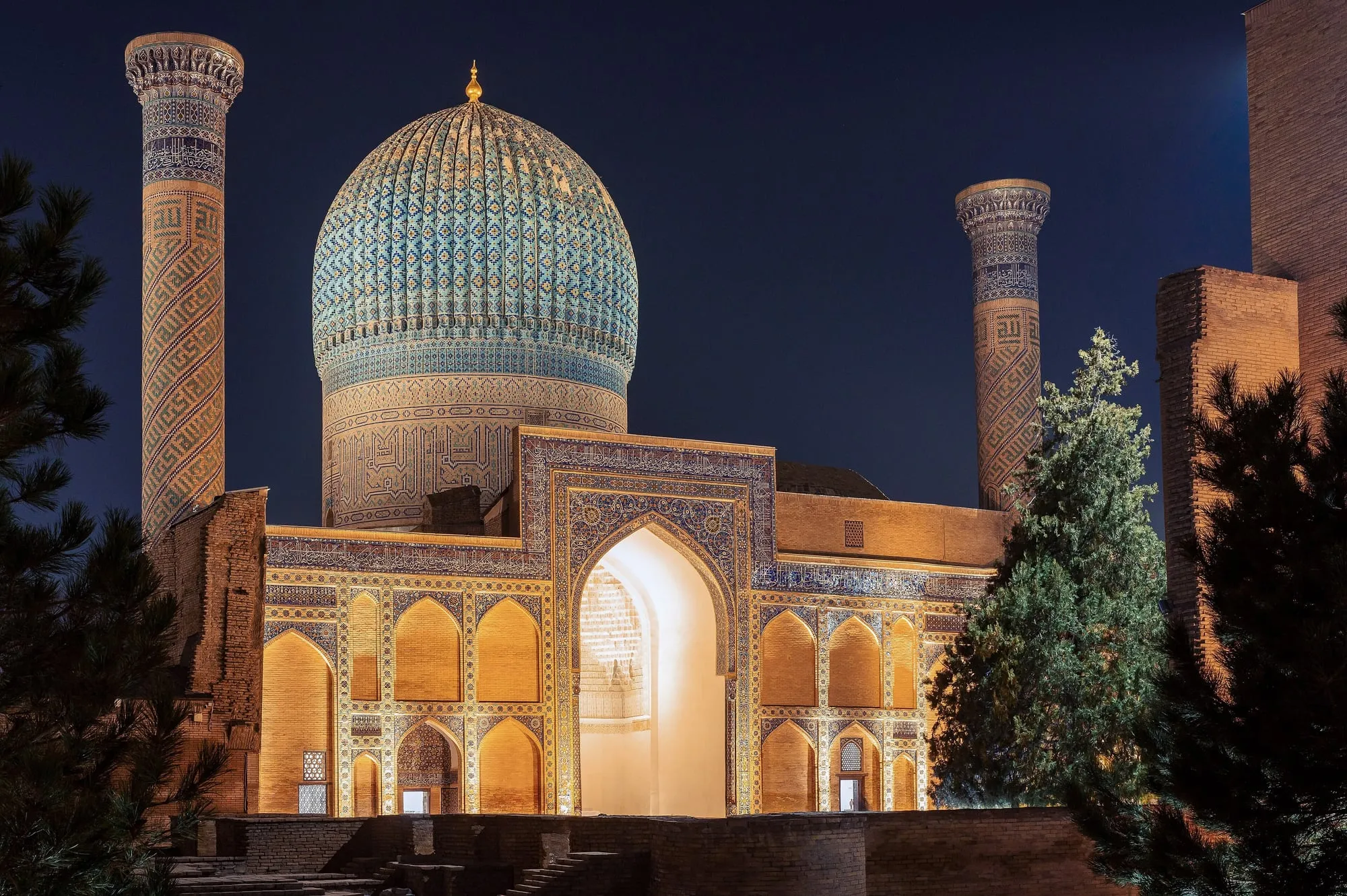
Add Gur-e Amir if your arrival and the day's opening arrangements allow. This is a Timurid dynastic mausoleum associated with Amir Timur. Pairing it with Registan introduces two different building types, a burial complex and a group of madrasahs. If the train arrives late, move Gur-e Amir to tomorrow and drop the optional museum. Uzbekistan Travel: mausoleums
Stay for two nights in the same accommodation. A location near the historic sights can reduce repeated rides; check the map pin and the walking route to Registan before booking.
05
Day 3: Shah-i-Zinda, Bibi-Khanym and one optional museum
Use the full Samarkand day for the Shah-i-Zinda–Bibi-Khanym–Siyob group of visits. Begin with Shah-i-Zinda, a religious and funerary ensemble linked to Qusam ibn Abbas. Its blue and turquoise tilework is one reason to give individual buildings time, rather than treating the complex as a single photo stop. Dress for a religious visit and follow the instructions at each entrance. Uzbekistan Travel: Shah-i-Zinda
Continue to Bibi-Khanym Mosque and Siyob Bazaar, allowing a meal and a rest between visits. The tourism authority's Uzbek Samarkand inventory dates Bibi-Khanym to 1399–1404. That makes it a useful comparison with the madrasahs you saw at Registan, which were built in different periods. Uzbekistan Travel: Samarkand monuments
For the remaining part of the day, choose according to your interests. Ulugh Beg Observatory focuses the visit on astronomy: its preserved underground instrument remains belong to a research site built in 1428–1429. The Uzbek account also describes the work's catalogue of 1,018 stars. Uzbekistan Travel: Ulugh Beg Observatory
For ancient urban history, choose Afrasiab instead; the archaeological site is in northern Samarkand. Check the museum's current access separately before making it your indoor visit. We would choose one of these additions, or neither if Gur-e Amir moved from Day 2. Uzbekistan Travel: Afrasiab
06
Day 4: move to Bukhara and start at Lyabi Hauz
Take a train from Samarkand to Bukhara that leaves you a usable afternoon. Check the arrival station before arranging the ride: Bukhara-1 is in Kogon, outside the historic centre. The Bukhara Biennial's Uzbek visitor guide identifies the station as Buxoro-1, Kogon; use its location information, then obtain current train times from the railway. Bukhara Biennial: getting to Bukhara
After leaving luggage, start with Lyabi Hauz. The ensemble brings together Kukeldash Madrasah, Nadir Divan Begi Madrasah and a khanaka, a building associated with Sufi religious life. Uzbekistan Travel: Lyabi Hauz
Continue through the trading domes if you have time, leaving longer visits for tomorrow. Choose accommodation in or near the old city for these two nights, and ask how close a vehicle can get to its door. The relevant comparison is the walk with your luggage as well as the walk to the sights.
07
Day 5: Bukhara's brickwork, fortress and Poi Kalon
Start with the Samanid Mausoleum, then work towards Bolo Hauz Mosque and the Ark fortress. This western group also appears together in the tourism authority's Uzbek Bukhara programme. Our schedule keeps fewer stops and a longer break than that published sightseeing list. Uzbekistan Travel: Bukhara programme
At the Samanid Mausoleum, look at how patterned brickwork forms the decoration. The cube-shaped building has a central dome and four smaller corner domes. These details give you something specific to compare with the tiled monuments in Samarkand. Uzbekistan Travel: Samanid Mausoleum
Use the second part of the day for Poi Kalon: the Kalon minaret, Kalon Mosque and the exterior of Mir-i-Arab Madrasah. The complex took shape across the twelfth to sixteenth centuries; its buildings are not all the same age. Confirm access to each building individually rather than assuming a ticket admits you everywhere. Uzbekistan Travel: Poi Kalon
For a shorter walking day, keep the Ark and Poi Kalon as the main visits and take a car for the western stop. An out-of-town palace or workshop would replace part of this day. With only one full day in Bukhara, we would not add both city sights and a countryside excursion.
08
Days 6–7: return to Tashkent before the flight day
On Day 6, travel from Bukhara to Tashkent and sleep there. Choose the return train before committing to activities that morning. Checkout, the ride to Kogon, boarding, the rail journey and the ride to your Tashkent hotel all use part of the day. A train's station-to-station time is only one line in that sequence.
Keep the Tashkent evening simple. If you have energy and enough time, use it for the arrival-day visit you missed; otherwise, have dinner and prepare for departure. Recheck the airport terminal, flight time, luggage allowance and your airline's check-in deadline.
Day 7 belongs to the flight. The final night in Tashkent is our planning buffer, not a guarantee against disruption. If your departure is shortly after midnight, the airport journey may fall on the evening of Day 6: check the calendar date before booking the final hotel and return train.
09
How much time should you leave for transfers?
Keep half a day flexible for each of the first two city changes and most of Day 6 for the return to Tashkent. These are our scheduling allowances, not published journey times. If the available train falls later, move the affected visit to the full day or remove it.
For each journey, build a door-to-door plan using the steps below. We suggest aiming to reach the railway station about 60 minutes before departure, allowing time to find the correct entrance and board. This is an editorial target; follow any earlier requirement on your ticket.
| Part of the move | What to put in your plan |
|---|---|
| Hotel checkout and luggage | Pack before breakfast; confirm checkout and any storage arrangements |
| Ride to the departure station | Use the hotel's actual map pin and the station printed on the ticket; add traffic margin |
| Station and boarding | Our suggested arrival target: about 60 minutes before departure |
| Rail journey | Use the duration displayed for your particular train and date |
| Arrival station to hotel | Include meeting the driver or finding transport, then check-in or luggage drop |
| First sightseeing visit | Book a timed activity only after the complete transfer fits |
10
What should you book first?
First settle the international arrival and departure dates, including flights after midnight. Then choose the three rail legs as a set: Tashkent–Samarkand on Day 2, Samarkand–Bukhara on Day 4 and Bukhara–Tashkent on Day 6.
The railway's Uzbek public offer states that sales start at 10:00 local time at least 60 days before departure from the train's originating station; it also lets the carrier change the opening date. Treat this as a prompt to check, not a promise that every journey will appear on the same countdown. Uzbekistan Railways: public offer
Use the train-ticket booking guide for passenger details, payment and alternatives when your first choice is unavailable. Confirm the train and then place hotel nights and any timed guide or activity bookings around it. If you reserve hotels earlier, understand their cancellation conditions.
11
What needs to go into the seven-day budget?
Count six nights of accommodation, three intercity train tickets per person, meals across seven calendar days, your chosen sight admissions and local transport. Three rail legs create six station-to-hotel or hotel-to-station movements; add the arrival and departure airport transfers. You may combine some movements or use public transport, but do not omit them from the calculation.
A room or a car is often priced for the booking, while a train ticket is priced per traveler. Ask whether breakfast, admission tickets and any guide's expenses are included before comparing offers. Use the Uzbekistan trip-cost guide to build a comparable budget and the money guide to prepare payment options.
Keep optional guides, early check-in, workshops and a change-of-plan reserve as separate lines. The itinerary is a suggested route; it is not a priced package.
12
How should the plan change with the weather?
For a trip built around outdoor city walks, we would start by considering spring or autumn, then check the forecast for your exact week. Samarkand's and Bukhara's Uzbek tourism pages both describe hot summers; Bukhara's also stresses dry conditions. Samarkand climate, Bukhara climate
- In hot weather, put the main outdoor visit early, reserve the middle of the day for a meal and rest, and resume when conditions allow. Remove the optional museum transfer if the day becomes tiring.
- In cooler months, bring layers and keep an indoor alternative available. Confirm heating when choosing accommodation; a hotel photograph does not answer that question.
- Around holidays or events, check the actual calendar and opening arrangements before choosing train days. Do not build the week around a light show or performance until its date and time are confirmed.
13
How to adapt the route to your flights or pace
Change the night table first, then the sightseeing. Arriving in Samarkand removes the initial Tashkent–Samarkand leg; departing from Bukhara removes the return journey to Tashkent. Use either option only if the actual flight operates on your dates and suits the rest of your journey.
| Your situation | Suggested night split | What changes |
|---|---|---|
| Late arrival in Tashkent on Day 1 | Tashkent 1 → Samarkand 2 → Bukhara 2 → Tashkent 1 | Drop Day 1 sights; leave them optional after the return |
| Arrive in Tashkent, depart from Bukhara on Day 7 | Tashkent 1 → Samarkand 2 → Bukhara 3 | Day 6 becomes a second full Bukhara day; no return train |
| Arrive in Samarkand, depart from Tashkent | Samarkand 3 → Bukhara 2 → Tashkent 1 | Use arrival day for rest and preserve two full days in Samarkand |
| Prefer fewer hotel changes | Tashkent 2 → Samarkand 3 → Tashkent 1 | Remove Bukhara; slow down the two-city route |
14
Travel independently or arrange selected parts
You can use this itinerary to plan an independent trip. Choose and book the trains, hotels and visits yourself, keeping the transfer allowances in the schedule. A guide is an optional addition for the depth of explanation you want at particular sights.
OxusRoad can also arrange selected services, such as rail travel, station transfers, accommodation and local guides, or coordinate the full trip. Send the travel dates, group size, arrival and departure cities, and which parts you want arranged through the trip inquiry page. Scope, availability and price are confirmed before arrangements are made.
Common questions
Is seven days enough for Uzbekistan?
Seven calendar days are enough for this focused Tashkent–Samarkand–Bukhara route, with six nights and no remote side trips. The plan provides one full day in Samarkand and one in Bukhara, plus arrival-day visits. If you want slower museum visits, more rest or Khiva as well, allow more days or remove a city.
Would skipping Khiva be a mistake?
Skipping Khiva is a choice about the week you have. This route gives Samarkand and Bukhara two nights each and returns to Tashkent before departure. If Khiva matters more to you than one of those cities, replace that city and rebuild the transport plan rather than adding a fourth stop.
Can I arrive in Tashkent and take a train straight to Samarkand?
It may fit a particular flight and train, but our base route spends the first night in Tashkent. An independent flight-to-train connection must allow for arrival formalities, baggage and travel to the correct station, as well as delays. If you choose that variant, compare the whole transfer before paying for a fixed train.
Can I travel from Bukhara to Tashkent on the day of my flight?
It can look possible on a timetable, but we recommend returning on Day 6 and flying on Day 7. The alternative places the train journey, city transfer and airline deadline in the same day. For a short trip with a fixed international flight, keeping a final Tashkent night is our preferred trade-off.
Do I need a driver for the whole week?
The base itinerary uses trains between cities, so a full-week driver is not part of the plan. Arrange local rides where needed and consider a guide for selected sightseeing blocks. If you want an out-of-town excursion, decide what it replaces before requesting the car and guide.
Sources and checks
Sources checked on 13 September 2026, primarily in Uzbek. The route, night split and time allowances are OxusRoad editorial recommendations. This was a source review, not a field visit or a live availability check. Confirm trains, opening arrangements and prices for your dates.
- Uzbekistan Travel: Chorsu
Uzbek; old-city location, nearby buildings and market food categories.
- Uzbekistan Travel: Hazrat Imam
Uzbek; ensemble names. No current manuscript-display or admission claim taken from this page.
- Uzbekistan Travel: Registan
Uzbek; the three madrasahs.
- Uzbekistan Travel: mausoleums
Uzbek; Gur-e Amir as a Timurid dynastic burial complex.
- Uzbekistan Travel: Shah-i-Zinda
Uzbek; religious character, Qusam ibn Abbas association and tilework.
- Uzbekistan Travel: Samarkand monuments
Uzbek; Bibi-Khanym construction dates and monument inventory.
- Uzbekistan Travel: Ulugh Beg Observatory
Uzbek; 1428–1429 construction, instrument remains and star catalogue.
- Uzbekistan Travel: Afrasiab
Uzbek; archaeological site in northern Samarkand.
- Bukhara Biennial: visitor information
Uzbek; 2025 event guide, used only for Bukhara-1 station's Kogon location. Its old timetables are not used.
- Uzbekistan Travel: Lyabi Hauz
Uzbek; components of the ensemble.
- Uzbekistan Travel: Bukhara sightseeing programme
Uzbek; city sightseeing groups only. Its timetable and packaged activities are not reproduced.
- Uzbekistan Travel: Samanid Mausoleum
Uzbek; brickwork and building form.
- Uzbekistan Travel: Poi Kalon
Uzbek; ensemble components and broad construction period.
- Uzbekistan Railways: public offer
Uzbek; sale-opening terms. Actual seats, trains and fares remain date-specific.
- Uzbekistan Travel: Samarkand
Uzbek; qualitative summer-heat description only.
- Uzbekistan Travel: Bukhara
Uzbek; qualitative hot, dry summer description only.