


THE SHORT ANSWER
Plan two full days in Samarkand, two in Bukhara (three with the last emir’s country palace), one in Khiva (two with the desert fortresses) and one in Tashkent. Two full days need three nights. Foreign adults pay 100,000 som at the Registan, 60,000 at Bukhara’s Ark and 425,000 at Tashkent’s Islamic Civilization Center.
Key facts
- Registan ticket, foreigners
- 100,000 som adults; 50,000 som ages 7–18; free under 7Source ·
- Bukhara Ark, foreigners
- 60,000 som; most other Bukhara museums 20,000 som (list in force since 1 Jan 2025)Source ·
- Train Tashkent → Khiva
- Jaloliddin Manguberdi 752: 07:00 → 14:42, every day except Sunday; economy 780,000 somSource ·
More key facts10
- Registan opening hours
- Every day: 07:00–24:00 from 20 Feb to 20 Nov, 08:00–20:00 from 20 Nov to 20 FebSource ·
- Gur-e Amir and Ulugh Beg Observatory, foreigners
- 75,000 som each; children 65,000 somSource ·
- Islamic Civilization Center, foreign adult
- 425,000 som with audio guide, 2-hour session; open daily 09:00–22:00Source ·
- Afrosiyob Tashkent → Samarkand
- 2 h 25 min; economy 311,000 somSource ·
- Afrosiyob Tashkent → Bukhara
- 4 h 6 min; economy 509,000 somSource ·
- Train Bukhara → Khiva
- No. 706: Buxoro-1 15:45 → Khiva 20:25, every day except Monday; economy 270,800 somSource ·
- Train ticket sales
- Open 60 days before departure, at 10:00 local timeSource ·
- Samarkand → Shahrisabz by train
- Sundays only: Afrosiyob 774 08:56 → 11:12, back on 773 at 16:24; economy 224,000 somSource ·
- Savitsky Museum, Nukus
- 100,000 som foreign adults; 09:00–18:00, closed MondaysSource ·
- Tashkent → Chimgan by public transport
- Express 08:47 Tashkent South → Chinorkent 10:33, 30,000 som cash; then minibus 324, 10,000 somSource ·
All guides in this section
What to see in Samarkand: the Registan and Timur’s monuments
Give Samarkand two full days: three nights if you arrive in the evening and leave in the morning. Day 1 is the Registan in the morning and Gur-e Amir after lunch. Day 2 starts early at Shah-i-Zinda, moves on to Bibi-Khanym and Siyob Bazaar next door, and ends with one museum: Afrasiab for Samarkand before the Timurids, or the Ulugh Beg Observatory for astronomy. With only one day, keep the Registan and add Gur-e Amir or Shah-i-Zinda; Bibi-Khanym and the bazaar need another half-day.
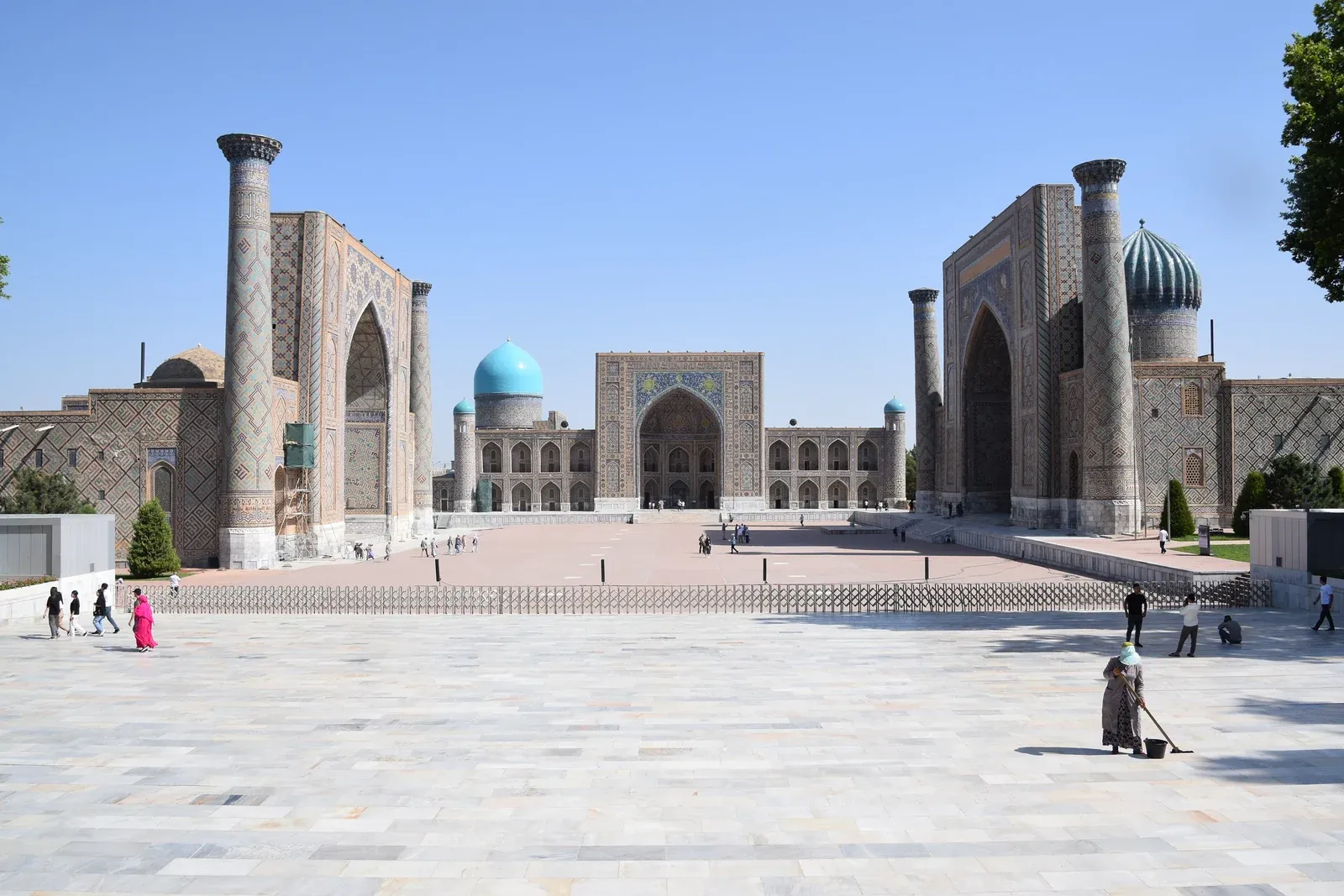
At the Registan, visit the three madrasas one by one rather than only the view from the square. The Ulugh Beg madrasa dates from 1417–1420, Sher-Dor opposite from 1619–1636, and Tilla-Kori was finished around 1660: two centuries separate the first from the other two. Gur-e Amir is the Timurid family mausoleum, and Timur’s tombstone is a block of dark nephrite. Shah-i-Zinda is a street of mausoleums and a place of pilgrimage, climbed by a staircase: go early, speak quietly and keep doorways clear.
Each site sells its own ticket. The Registan’s official service, tickets.registon.uz, charges 100,000 som for a foreign adult, 50,000 for ages 7–18 and nothing for children under 7; citizens of Uzbekistan pay 15,000. It has only two categories, citizens of Uzbekistan and citizens of other countries, so visitors from Russia, Kazakhstan and the rest of the CIS pay the foreign rate. Gur-e Amir, Bibi-Khanym, the Afrasiab Museum and the Observatory sell online through iTicket at 50,000–80,000 som for foreign adults (26 September 2026). Shah-i-Zinda is on neither service.
The sites close late. The Registan opens every day, 07:00–24:00 from 20 February to 20 November and 08:00–20:00 in winter, with a music show at 21:00. Gur-e Amir, Bibi-Khanym, the Afrasiab Museum and the Observatory close at 23:00 and Siyob Bazaar at midnight, according to the Registan directorate’s notice of 9 September 2026. Do not start a full visit an hour before closing.
The Afrosiyob links Tashkent’s Central station (Toshkent Markaziy) with Samarkand in 2 h 25 min for 311,000 som in economy, the fare in force since 1 February 2026; Tashkent to Samarkand by train has the full timetable. Samarkand is also the base for a day in Shahrisabz and for Penjikent, across the Tajik border at Jartepa–Sarazm.
Stay near the Registan for an evening walk back to the square, on Oqsaroy Street by Gur-e Amir, or on the Bibi-Khanym side for the market. In summer, visit early, take a proper break at midday and drop the museum first. Day plans, walking groups and hotel areas are in the Samarkand city guide.
| Sight | What it is | Ticket, foreign adult | Hours | Time needed |
|---|---|---|---|---|
| Registan | Three madrasas: Ulugh Beg (1417–1420), Sher-Dor (1619–1636), Tilla-Kori (about 1660) | 100,000 som; ages 7–18 50,000; under 7 free | 07:00–24:00 (20 Feb–20 Nov); 08:00–20:00 in winter; show at 21:00 | 2–3 h |
| Gur-e Amir | Timurid mausoleum; Timur’s dark nephrite tombstone | 75,000 som; children 65,000 | Until 23:00 | 45–60 min |
| Shah-i-Zinda | Street of mausoleums and place of pilgrimage, up a staircase | Not sold online | Not published | 60–90 min |
| Bibi-Khanym | Mosque built on Timur’s orders in 1399–1404 | 50,000 som; children 35,000 | Until 23:00 | 45–60 min |
| Siyob Bazaar | Dried fruit, nuts, Samarkand bread, halva | Free | Until 24:00 | 30–45 min |
| Afrasiab Museum | 7th-century Sogdian wall paintings from the palace of Varkhuman | 80,000 som; children 70,000 | Until 23:00 | 60–90 min |
| Ulugh Beg Observatory | Observatory of 1428–1429; star catalogue of 1,018 entries | 75,000 som; children 65,000 | Until 23:00 | 60–90 min, instead of Afrasiab |
What to see in Bukhara: the old town, from Lyabi-Hauz to the Ark
Allow two full days for Bukhara’s old town: day 1 around Lyabi-Hauz, the trading domes and Poi Kalon, day 2 for the Ark and the monuments to the west. A third day adds Sitorai Mohi-Khosa, the country palace of the last emir, 4 km to the north. With an evening arrival and a morning departure, that makes three or four nights.
On the third day, pair the palace with the Bahauddin Naqshband memorial complex in Qasri Orifon, a pilgrimage site in Kogon district, or with the 19th-century merchant’s house of the Khojaev family in the Gozion quarter (30,000 som). Both need a car or a taxi; do not add either to a day that ends with a train.
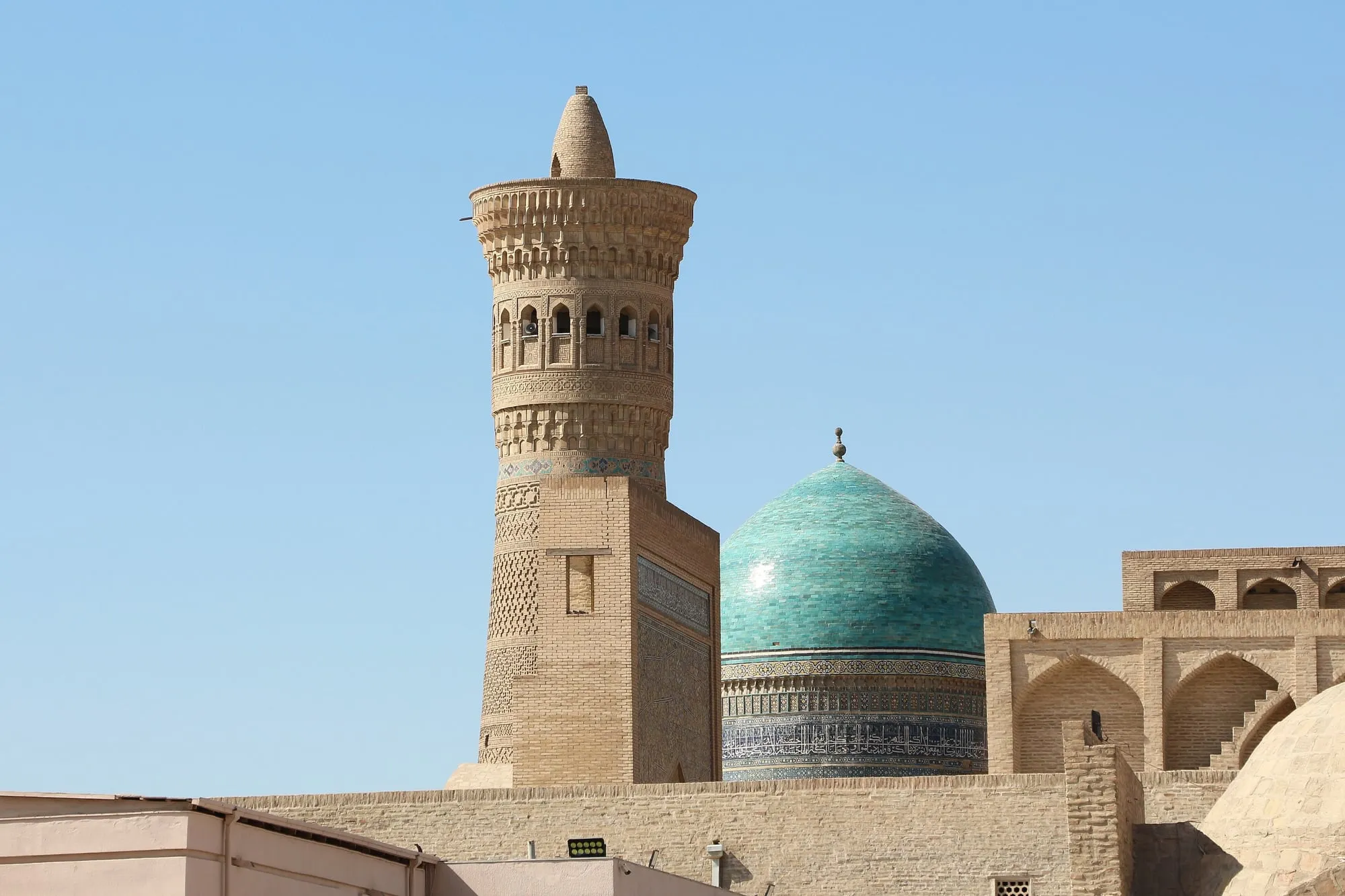
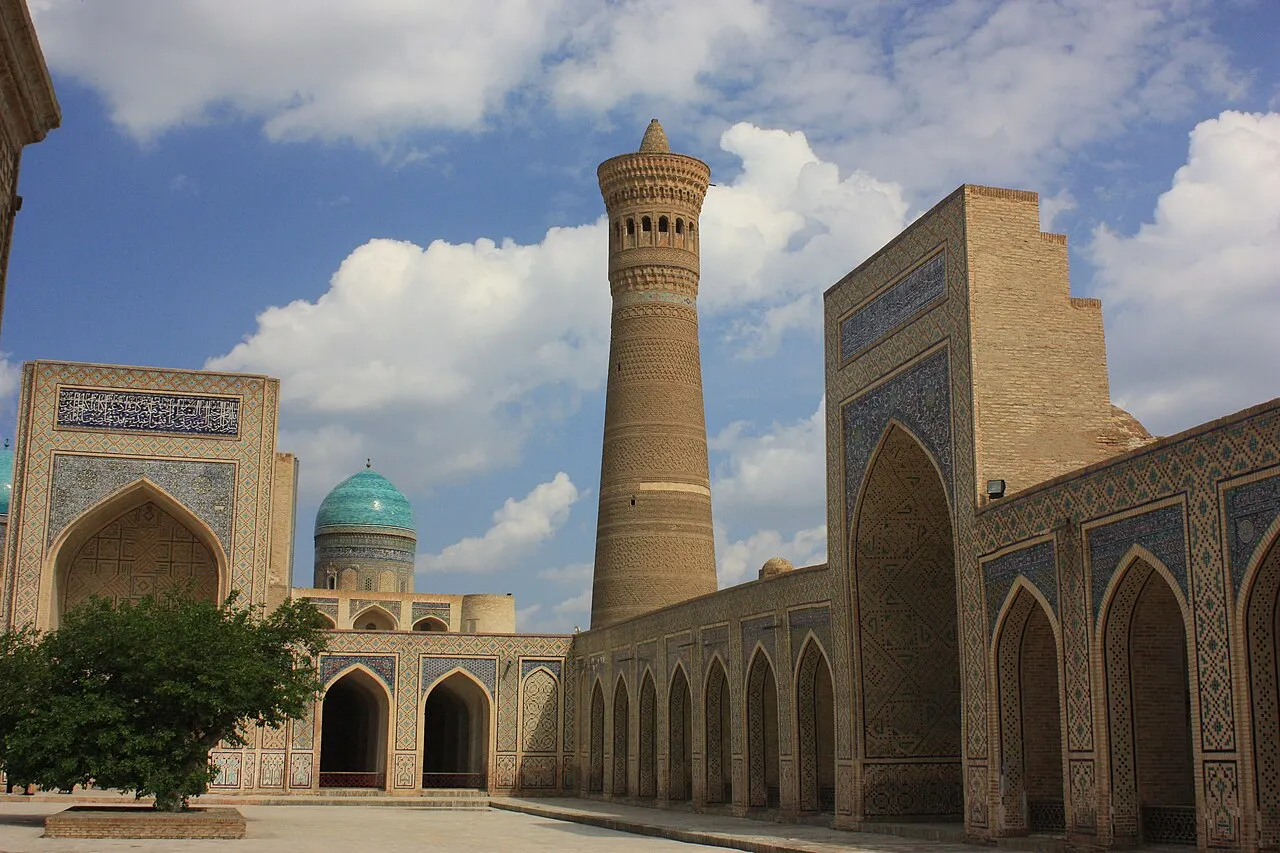
UNESCO inscribed the historic centre as a whole in 1993, not monument by monument. Walk it in three groups: the central route from Lyabi-Hauz through the trading domes to Poi Kalon; the western group of the Ark, Bolo-Hauz, the Samanid Mausoleum and Chashma-Ayub; and the outlying sites by car, Chor Minor and the palace. At Poi Kalon, the Kalon minaret dates from 1127, while the mosque and the Mir-i-Arab madrasa around the square are 16th-century.
Several monuments on the central route house museums: carpets in the Magoki-Attori mosque, calligraphy in the Ulugh Beg madrasa, woodcarving in the Abdulaziz Khan madrasa and literature in the Kukeldash madrasa. The Bukhara State Museum-Reserve sells a separate ticket for each. Its price list, in force since 1 January 2025 and still posted on 26 September 2026, charges foreign visitors 60,000 som for the Ark and for Sitorai Mohi-Khosa, 30,000 for the Fayzulla Khojaev house and 20,000 for each smaller museum. Adult citizens of Uzbekistan pay 10,000 or 5,000 som; the list has no separate rate for CIS visitors.
The same list prices a museum guide in a foreign language at 60,000 som, or 120,000 for the Ark or the palace, an audio guide at 20,000 and photographing the exhibits at 30,000. The museums open 09:00–18:00 with no day off, 08:00–21:00 in the season and 09:00–17:00 on Tuesdays, Wednesdays and Sundays: arrive before 17:00 whatever the day.
From Tashkent, the Afrosiyob reaches Bukhara in 4 h 6 min for 509,000 som in economy. From Samarkand it takes about 1 h 35 min, against 4½–5½ hours by car for 293 km. Trains stop at Buxoro-1 station in Kogon, outside the old town, so book the transfer with your hotel. Samarkand to Bukhara compares the train and the car.
In mosques and shrines, cover shoulders and knees. Day plans, hotel areas and the Naqshband complex are in the Bukhara city guide.
| Sight | What it is | Ticket, foreigners | Hours | Time needed |
|---|---|---|---|---|
| Lyabi-Hauz and the trading domes | Pool framed by the Kukeldash madrasa and the Divanbegi buildings; three domed bazaars | Square free; Kukeldash museum 20,000 som | Open square; museums 09:00–18:00 | 2–3 h with one museum |
| Poi Kalon | Kalon minaret (1127), Kalon mosque and Mir-i-Arab madrasa (16th century) | Not on the museum-reserve list | Open square | 60–90 min |
| Magoki-Attori and the madrasa museums | Carpets; calligraphy in the Ulugh Beg madrasa; woodcarving in the Abdulaziz Khan madrasa | 20,000 som each | 09:00–18:00 | 30–45 min each |
| The Ark | Citadel; the museum-reserve has been based here since 1945 | 60,000 som | 09:00–18:00 | 2 h |
| Samanid Mausoleum | Mausoleum whose fired bricks form the decoration | Not on the museum-reserve list | Not published | 30 min |
| Chashma-Ayub | Museum of Bukhara’s water supply | 20,000 som | 09:00–18:00 | 30–45 min |
| Chor Minor | Madrasa of Khalif Niyazkul (1807), east of the centre | Not on the museum-reserve list | Not published | 20–30 min |
| Sitorai Mohi-Khosa | Country residence of the last emir, early 20th century; White Hall of carved plaster and mirrors | 60,000 som | 09:00–18:00 | Half a day with the drive |
What to see in Khiva: Ichan-Kala and the desert fortresses
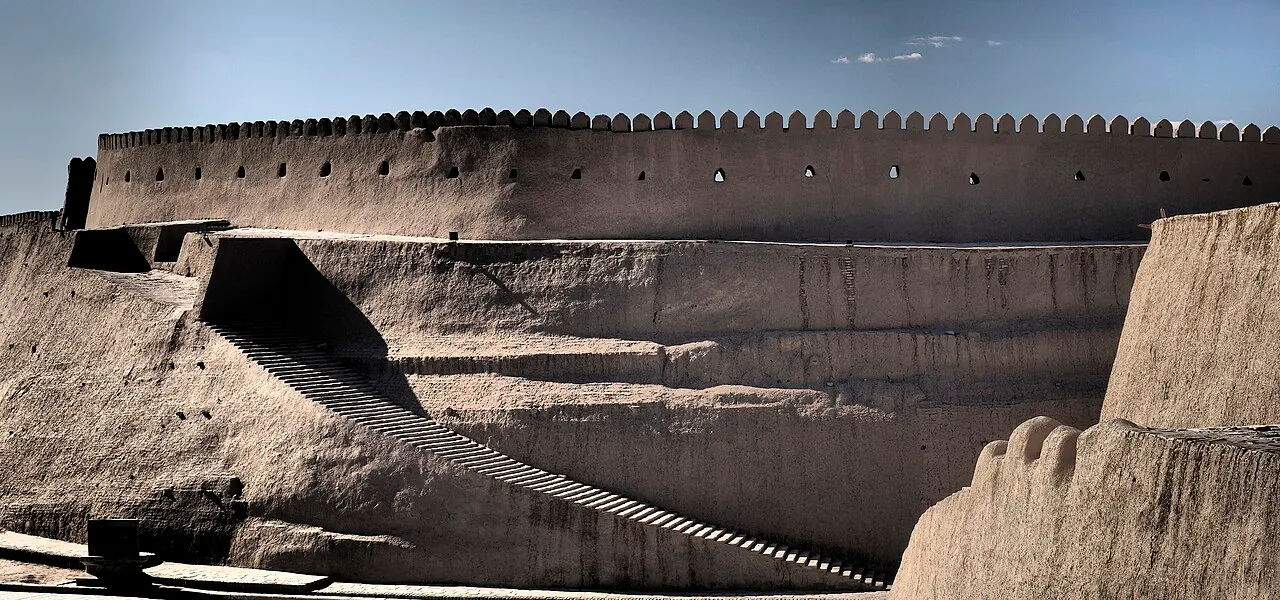
One full day covers a first visit to Ichan-Kala, Khiva’s walled inner town: Kalta Minor, the Kunya Ark, the Juma Mosque and Tosh Hovli. Two days let you add Pahlavon Mahmud, Islam Khoja, a workshop or the Nurullaboy Palace without rushing. The desert fortresses need a day of their own, so two days in town plus the fortresses mean three full days and four nights. For that second day, the Khorezm tourism programme lists the khans’ history exhibition in the Muhammad Rahim Khan II madrasa, music history at Qozikalon, woodcarving at Khojash Mahram and silk-carpet weaving at Yakubboy Khoja.
UNESCO inscribed Ichan-Kala in 1990: a rectangle of about 650 by 400 metres, covered on foot, where the streets and houses matter as much as the monuments. People live and work inside the walls: keep doorways clear and ask before photographing anyone. At the Juma Mosque, the low hall of wooden columns is lit through two openings in the roof; give it half an hour in the late morning.
Entry to Ichan-Kala is paid, and most visitors come in through Ota Darvoza, the west gate. The museum-reserve publishes no tariff online: its ticket page listed none on 26 September 2026. At the desk, ask which museums, mausoleums and minaret climbs the ticket covers and for how many days, and keep it with you until you leave.
The desert fortresses stand in the Ellikqala district of Karakalpakstan, a day trip by car. Start with Ayaz-Kala, three mud-brick fortresses with Ayaz 1 on its hill; continue to Toprak-Kala, a town of 500 by 350 metres and a royal residence of the 2nd–3rd centuries AD; add Kyzyl-Kala, 1.3 km from Toprak, if the heat allows. Allow 2–3 hours at the sites plus the drive and lunch, in a car that waits for you; a 4×4 is not required.
The Jaloliddin Manguberdi (train 752) leaves Tashkent at 07:00 and reaches Khiva at 14:42 every day except Sunday, for 780,000 som in economy, and its seats go weeks ahead. Night train 056 leaves Tashkent South at 21:45 on Tuesdays, Wednesdays, Fridays and Saturdays and arrives at 12:09 (open berth 245,140 som). From Bukhara, train 706 runs from Buxoro-1 at 15:45 to Khiva at 20:25, every day except Monday, for 270,800 som in economy. By air, you land at Urgench and continue by road. Details: Tashkent to Khiva and Bukhara to Khiva.
Summers are hot and winters drop below freezing: walk early and keep the minaret climbs optional. The Khiva city guide has the day plan and hotel areas, and the fortress day is under desert fortresses.
| Monument | What it is | Time needed |
|---|---|---|
| Ota Darvoza and Kalta Minor | West gate; wide minaret in glazed tiles, left unfinished in 1855 | 20–30 min |
| Kunya Ark | The khans’ citadel: reception halls, mint, mosques; late 17th century, rebuilt in the early 19th | 60–90 min |
| Juma Mosque | Low hall of wooden columns lit by two openings in the roof | 30–45 min |
| Tosh Hovli | Palace of Allakuli Khan (1830–1838), with blue and white tiles | 60–90 min |
| Pahlavon Mahmud | Pilgrimage shrine; brick mausoleum of 1810–1835, burial place of Khiva’s rulers | 30–45 min |
| Islam Khoja | Small madrasa and tall minaret (1908–1910) | 30–45 min |
| Nurullaboy Palace | Parquet floors, painted ceilings, porcelain stoves | 60–90 min plus travel time |
| Desert fortresses | Ayaz-Kala, Toprak-Kala (2nd–3rd centuries AD) and Kyzyl-Kala, Ellikqala district | 2–3 h at the sites plus the drive |
What to see in Tashkent: old town, Chorsu, metro and museums
One full day is enough for a first look at Tashkent: the Khast Imam complex in the morning, Chorsu Bazaar and lunch, a metro ride, then the centre or a museum. The Islamic Civilization Center justifies a second day. Arriving in the evening, with a train on the morning of the day after next, book two nights.
Khast Imam, the heart of the old town, surrounds the tomb of Kaffal Shashi, with the Barak Khan madrasa and the Tilla Sheikh mosque. Some buildings are in religious use, so dress as for a mosque and ask which ones you can enter. The Uthman Quran, which older guides place in its library, is now in the Islamic Civilization Center next door.
The Center opened on 17 March 2026 and follows pre-Islamic cultures, medieval science and Timurid art around its Quran Hall. A foreign adult pays 425,000 som for a two-hour session with an English or Russian audio guide; a live guide costs 480,000 som more per group of up to 10 (15 September 2026). It opens 09:00–22:00 every day. Arrive 15–20 minutes early; shorts are not allowed. Every ticket type is in the Islamic Civilization Center guide.
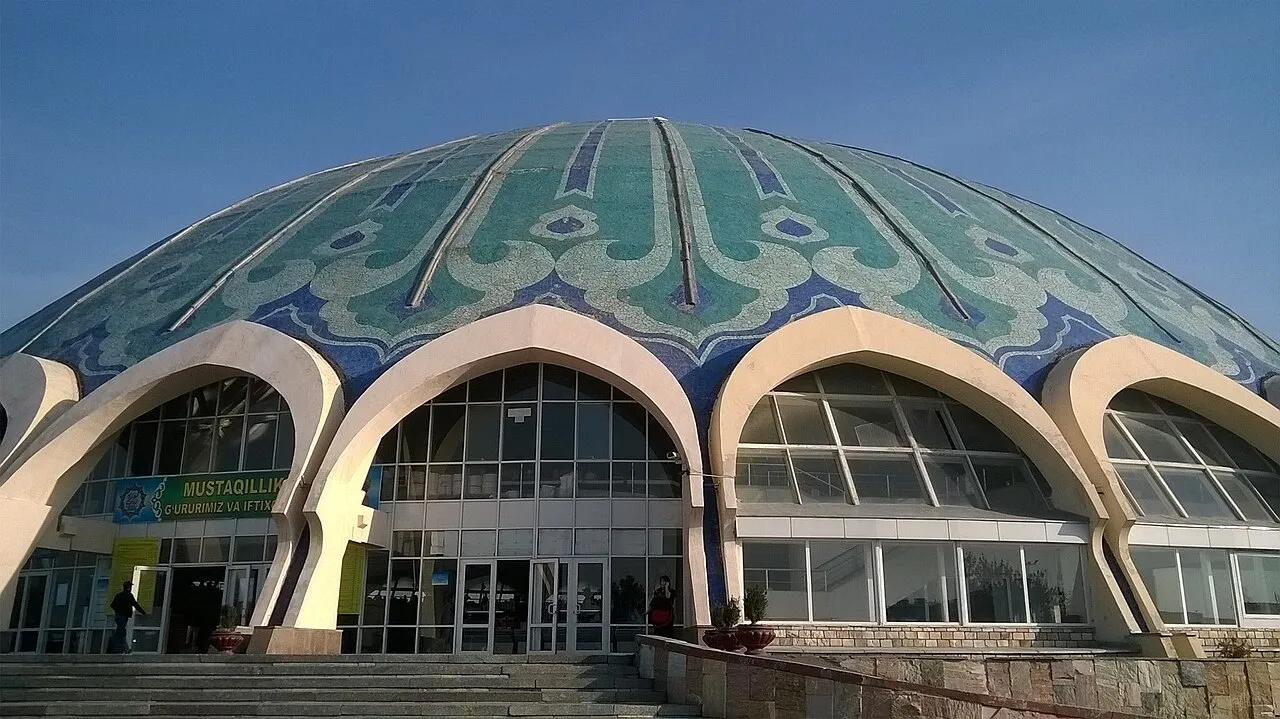
Chorsu Bazaar brings together the domed food hall, dairy, dried fruit and spices, with stalls of prepared food nearby; ask the price per kilo or per piece before anything is wrapped. The metro is worth a ride for its decorated stations: board at Chorsu and get off at Alisher Navoiy, which connects with Paxtakor towards the centre. A ride costs 1,700 som with a transport card or a contactless bank card, or 3,000 som with a QR ticket, and transport cards are sold at station windows without ID.
Rebuilt after the 1966 earthquake, Tashkent has had nine modernist buildings on the World Heritage List since July 2026. Two are on this route: the blue-domed Chorsu hall, completed in 1990, and Kosmonavtlar station on the same line as Chorsu. The circus, the Palace of Friendship of Peoples and the former Panorama cinema are seen from outside or during a show. The State Museum of Arts, also inscribed, is closed for reconstruction with no reopening date.
Tashkent’s two main stations are separate: the Afrosiyob to Samarkand leaves from Central (Toshkent Markaziy), while the night train to Nukus and the express to Chimgan leave from South (Toshkent Janubiy). Go to the one printed on your ticket. At the airport, licensed taxis and Yandex Go pick up in lane 1 outside arrivals, with city fares from 50,000 som (December 2025); the airport arrival guide covers the taxi rank, the buses and the way to a train. The Tashkent city guide has the full-day and arrival-day plans.
| Sight | What it is | Ticket | Time needed |
|---|---|---|---|
| Khast Imam complex | Tomb of Kaffal Shashi, Barak Khan madrasa, Tilla Sheikh mosque | No fee published | 60–90 min |
| Islamic Civilization Center | Museum opened on 17 March 2026; Uthman Quran in the Quran Hall; daily 09:00–22:00 | 425,000 som with audio guide (15 Sep 2026) | 2 h session |
| Chorsu Bazaar | Blue-domed market hall of 1990; spices, dried fruit, prepared food | Free | 90 min with lunch |
| Metro: Chorsu, Alisher Navoiy, Kosmonavtlar | Decorated stations; Kosmonavtlar is on the same line as Chorsu | 1,700 som by card, 3,000 by QR ticket (14 Sep 2026) | 60–75 min |
| Amir Timur Square | Equestrian statue of Timur; Hotel Uzbekistan (1974); Timurid History Museum next door | Square free | 60–90 min |
| Museum of Applied Arts | Ceramics, embroidery, carpets, musical instruments | No fee published | 60–90 min plus travel time |
Beyond the four cities: Shahrisabz, Fergana, Nukus and more
Six places repay a day or more outside the four cities. Shahrisabz and the Chimgan mountains fit into a day; Nukus needs at least a night; the Fergana Valley, the Aral shore, Nuratau and Termez need two days or more, so put them in the calendar before the cities.
Shahrisabz, Timur’s home town, is a day out from Samarkand: about 90 km and 2 hours each way by car over the Takhtakaracha pass, which snow closes for a few hours at a time in winter. On Sundays, Afrosiyob 774 leaves Samarkand at 08:56 and arrives at 11:12, and 773 returns at 16:24; economy costs 224,000 som each way, on sale for Sundays up to 22 November 2026. In 3–4 hours you see the ruined gateway of the Ak-Saray palace, begun in 1380, the crypt prepared for Timur at Dorus Saodat and the Kok Gumbaz mosque; the sites open 08:00–17:00. UNESCO has listed the centre as in danger since 2016 after demolitions, so expect wide new open spaces. More: Shahrisabz from Samarkand.
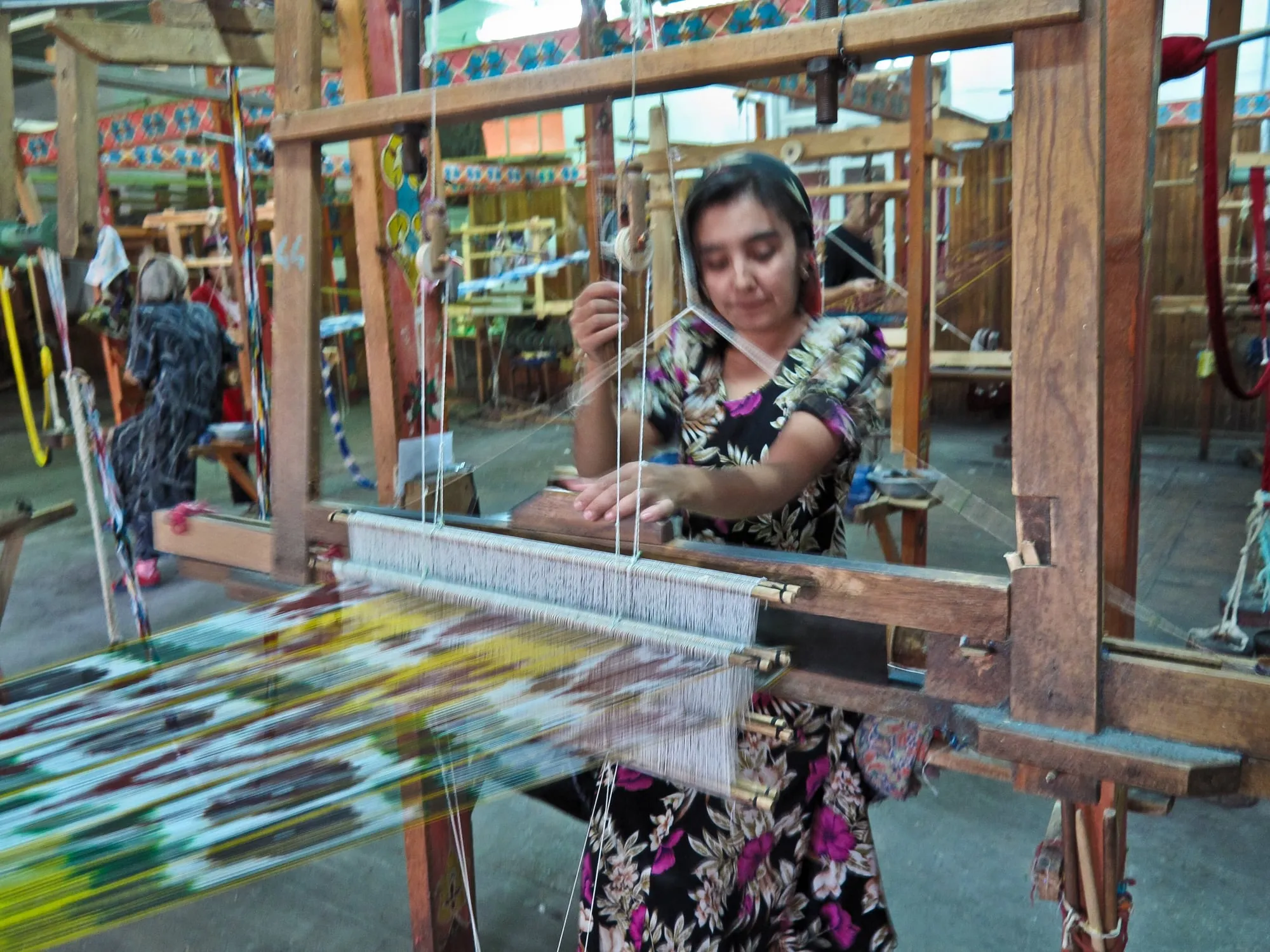
The Fergana Valley needs two or three full days, so three or four nights. In Kokand, see the palace of Khudoyar Khan and the Juma Mosque of 1819–1822, whose iwan rests on 98 wooden columns; in Rishtan, ceramics painted blue and turquoise; in Margilan, the Yodgorlik factory, founded in 1972, where atlas and adras silk are woven by hand. Book the workshops ahead and say whether you want to buy, watch or take a class. Trains reach Kokand and Margilan on the Angren–Pop line, which crosses the Kamchik pass area through a 19.2 km tunnel; cars take the pass road. More: Fergana Valley in 2–3 days.
Nukus is worth a night for the Savitsky Museum: about 100,000 objects, from 20th-century avant-garde painting to Karakalpak folk art and finds from ancient Khorezm. It opens 09:00–18:00 and closes on Mondays; foreign adults pay 100,000 som on the latest published list (October 2025), with no separate CIS rate. Night train 054 leaves Tashkent South at 16:00 and arrives at 08:18 (open berth 258,610 som), but berths sell out weeks ahead; the flight takes 1 h 40 min, and the drive from Khiva is about 200 km, or 2½–3 hours. The Aral Sea means Muynak first, where stranded ships lie on the dried-up seabed: a full day from Nukus that does not reach the water. The present shore takes two days by 4×4 and a night in a yurt. More: Nukus and the Aral Sea.
Chimgan, Amirsoy and Lake Charvak lie 65–80 km north-east of Tashkent. Without a car, take the 08:47 express from Tashkent South to Chinorkent (30,000 som in cash), then minibus 324 (10,000 som) to Amirsoy, Chimgan and the lake shore. The last trains back leave Chinorkent at 14:19 and Khodjikent at 16:12, so start early. Amirsoy’s gondola costs 115,000 som return on weekdays and 135,000 at weekends. Ski from late December to mid-March, swim from late May, and walk the foothills without a permit. More: Chimgan, Charvak and Amirsoy.
The Nuratau Mountains, between Samarkand and Bukhara, are a village stay rather than a sight. Book one named guesthouse in a village such as Sentob, in Nurata district, or Uhum, in Forish district, for one or two nights; two nights leave a full day for walking. One published walk from Sayyod covers 6 km in about 3 hours with 327 m of ascent. Aydarkul lake and its yurt camps are a separate stop: Aydar camp, for one, stands about 10 km from the water. The detour can replace the direct Samarkand–Bukhara journey. More: Nuratau village stay.
Termez, on the Afghan border, has Buddhist monasteries of the 1st–3rd centuries AD at Fayaz Tepa and Kara Tepa, the Zurmala stupa, the Hakim at-Termizi complex and an archaeological museum with more than 40,000 finds. Canada advises against all travel within 5 km of the border, and most of these sites lie inside that belt; Kara Tepa needs a border-guard permit requested by a licensed guide. Night train 080 leaves Tashkent daily at 21:13 and arrives at 11:17 (open berth 216,700 som); the flight takes about 1 h 25 min. More: Termez.
| Place | Base | Time needed | Getting there |
|---|---|---|---|
| Shahrisabz | Samarkand | 1 day; 3–4 h at the sites | Car: about 90 km, 2 h each way. Sunday Afrosiyob 08:56 → 11:12, back at 16:24; 224,000 som (24 Sep 2026) |
| Fergana Valley | Tashkent | 2–3 full days; 3–4 nights | Train to Kokand or Margilan on the Angren–Pop line (19.2 km tunnel), or car over the Kamchik pass |
| Nukus and the Aral Sea | Tashkent or Khiva | Nukus 1 night; Aral shore 2 days and a yurt night | Train 054: Tashkent South 16:00 → 08:18, open berth 258,610 som; flight 1 h 40 min; Khiva–Nukus about 200 km by car (24 Sep 2026) |
| Chimgan, Amirsoy, Charvak | Tashkent | 1 day | Express 08:47 Tashkent South → Chinorkent, 30,000 som cash; minibus 324, 10,000 som; last train back 14:19 (Sep 2026) |
| Nuratau villages and Aydarkul | Between Samarkand and Bukhara | 1–2 nights in one guesthouse | Car to Sentob or Uhum; the Aydarkul camps are a separate stop |
| Termez | Tashkent or Samarkand | 1 night between two night trains | Train 080: Tashkent 21:13 → 11:17, open berth 216,700 som; flight about 1 h 25 min (24 Sep 2026) |
Plan the nights city by city
Seven days are enough for Tashkent, Samarkand and Bukhara if you accept making choices; ten let you add Khiva; fourteen give more full days in the same four cities. The table shows the nights each city gets in our 7-, 10- and 14-day itineraries, which lay them out day by day with the trains.
If an excursion is the reason for the trip, whether Fergana, Nukus, the Aral Sea or Termez, fix it in the calendar first and fit the cities around it. Train tickets go on sale 60 days before departure at 10:00 Tashkent time: buy early for Khiva and Nukus, where seats sell out weeks ahead. For the summer heat and the months to choose, see when to go; for every route between the cities, see trains and routes.
Count nights from full days, not the other way round: an afternoon arrival and a morning departure two nights later leave one full day, not two.
| City | Full days | Nights needed | 7 days | 10 days | 14 days |
|---|---|---|---|---|---|
| Tashkent | 1; 2 with the Islamic Civilization Center | 2 | 1 + 1 at the end | 2 (+1 at the end if you return by train) | 2 + 2 at the end |
| Samarkand | 2 | 3 | 2 | 2 | 3 |
| Bukhara | 2; 3 with Sitorai Mohi-Khosa | 3–4 | 2 | 3 (2 if you return to Tashkent) | 3 |
| Khiva | 1; 2 with the fortresses | 2–3; 4 for two days plus the fortresses | Not included | 2 | 3 |
Common questions
How much do Samarkand’s main tickets cost in total?
380,000 som for a foreign adult on 26 September 2026: the Registan 100,000, Gur-e Amir 75,000, Bibi-Khanym 50,000, the Afrasiab Museum 80,000 and the Ulugh Beg Observatory 75,000. Each is bought separately: the Registan through its own ticket service, the other four through iTicket.
Are the sights open every day?
Most are. The Registan, the Bukhara museums and the Islamic Civilization Center have no day off, and the Shahrisabz sites open 08:00–17:00 daily. The Savitsky Museum in Nukus closes on Mondays. Plan the trains too: the Manguberdi to Khiva does not run on Sundays, train 706 from Bukhara not on Mondays, and the Afrosiyob to Shahrisabz runs on Sundays only.
In which order should I visit the four cities?
Tashkent, Samarkand, Bukhara and Khiva lie along the railway west, so most trips run in that order. After Khiva, fly home from Urgench or return to Tashkent by train or plane; the 10-day route shows both endings. Starting in Khiva and travelling east works too: see the eastbound version.
Can I add Kyrgyzstan, Kazakhstan or Tajikistan?
Yes. We arrange Kyrgyzstan as part of an Uzbekistan trip. For Kazakhstan and Tajikistan we give advice and arrange a few cross-border trips, such as a day from Tashkent to Shymkent and from Samarkand to Penjikent and Sarazm. Start with the Kyrgyzstan, Kazakhstan and Tajikistan guides.
Sources and checks100 sources
Ticket prices come from the Registan ticket service, iTicket and the Bukhara museum-reserve’s list, read on 26 September 2026; train times and fares from Uzbekistan Railways (14–24 September 2026); monument dates from UNESCO and the national tourism portal. Visiting times, day plans and nights per city are our recommendations.
- Registan ensemble directorate: online ticket service
Uzbek, Russian and English; the directorate’s official ticket service. Foreign adult 100,000 som, ages 7–18 50,000, under 7 free; citizens of Uzbekistan 15,000; two categories only (citizens of Uzbekistan, citizens of other countries); open 07:00–24:00 from 20 Feb to 20 Nov and 08:00–20:00 from 20 Nov to 20 Feb, no day off. Checked 26 September 2026.
- Registan directorate: evening opening hours, 9 September 2026
Uzbek. Registan and Siyob close at 24:00; Gur-e Amir, Bibi-Khanym, the Afrasiab Museum and the Ulugh Beg museum complex at 23:00; music show daily at 21:00. Read 13 September 2026.
- iTicket: Gur-e Amir mausoleum
Russian; online ticket seller. Foreigners 75,000 som, foreign children 65,000. Checked 26 September 2026.
- iTicket: Bibi-Khanym
Russian. Foreigners 50,000 som, foreign children 35,000. Checked 26 September 2026.
- iTicket: Afrasiab Museum
Russian. Foreigners 80,000 som, foreign children 70,000. Checked 26 September 2026.
- iTicket: Ulugh Beg Observatory
Russian. Foreigners 75,000 som, foreign children 65,000. Checked 26 September 2026.
- Uzbekistan Travel: monuments of Samarkand
Uzbek; national tourism portal. Names, locations and dates of the monuments, including Tilla-Kori (finished around 1660). Read 13 September 2026.
- Uzbekistan Travel: Ulugh Beg madrasa, Samarkand
Uzbek. Built in 1417–1420. Read 13 September 2026.
- Uzbekistan Travel: Sher-Dor madrasa
Uzbek. Built in 1619–1636. Read 13 September 2026.
- Uzbekistan Travel: Gur-e Amir
Uzbek. Timurid mausoleum; Timur’s nephrite tombstone. Read 13 September 2026.
- Uzbekistan Travel: Bibi-Khanym mosque
Uzbek. Built on Timur’s orders in 1399–1404. Read 13 September 2026.
- Uzbekistan Travel: Ulugh Beg Observatory
Uzbek. Built in 1428–1429; star catalogue of 1,018 entries. Read 13 September 2026.
- Samarkand regional authority: Shah-i-Zinda
Uzbek (Cyrillic). Layout of the ensemble, staircase, place of pilgrimage. Read 13 September 2026.
- Samarkand regional authority: Afrasiab Museum
Uzbek (Cyrillic). Museum on the ancient site; wall paintings from the palace of Varkhuman. Read 13 September 2026.
- Competition Committee: official visit to Samarkand, 15 June 2024
Uzbek. Dates the Afrasiab paintings to the 7th century. Read 13 September 2026.
- Uzbekistan Travel: Samarkand
Uzbek. What Siyob Bazaar sells. Read 13 September 2026.
- Bukhara State Museum-Reserve: ticket prices
Uzbek (Cyrillic); official list in force since 1 January 2025 and still posted. Foreigners: Ark and Sitorai Mohi-Khosa 60,000 som, Fayzulla Khojaev house 30,000, other museums 20,000; local adults 10,000 or 5,000; guide in a foreign language 60,000 (Ark and palace 120,000); audio guide 20,000; photography 30,000; hours 09:00–18:00, 08:00–21:00 in season, 09:00–17:00 on Tuesdays, Wednesdays and Sundays, no day off. Checked 26 September 2026.
- Bukhara State Museum-Reserve
Uzbek. The museum-reserve has been based in the Ark since 1945. Read 13 September 2026.
- UNESCO: Historic Centre of Bukhara
English. The historic centre inscribed as a whole in 1993. Read 13 September 2026.
- Uzbekistan Travel: Poi Kalon ensemble
Uzbek. Minaret of 1127; mosque and Mir-i-Arab madrasa of the 16th century. Read 13 September 2026.
- Uzbekistan Travel: Lyabi-Hauz
Uzbek. Kukeldash madrasa, Divanbegi madrasa and khanqah around the pool. Read 13 September 2026.
- Uzbekistan Travel: Samanid Mausoleum
Uzbek. Fired-brick decoration. Read 13 September 2026.
- Uzbekistan Travel: Bukhara
Uzbek. Chor Minor, the madrasa of Khalif Niyazkul, opened in 1807; dress in holy places. Read 13 September 2026.
- Uzbekistan Travel: Sitorai Mohi-Khosa
Uzbek. Country residence of the last emir, 4 km north of Bukhara, early 20th century, White Hall. Read 13 September 2026.
- Uzbekistan Travel: Bahauddin Naqshband complex
Uzbek. Qasri Orifon, Kogon district; burial place of the Sufi teacher and a pilgrimage site. Read 13 September 2026.
- Bukhara State Museum-Reserve: the merchant’s house
Russian. House of Ubaydullo Khoja, father of Fayzulla Khojaev, in the Gozion quarter. Read 13 September 2026.
- Tourfixer: Samarkand to Bukhara by train or car
English; Tashkent tour operator, 5 March 2026. Afrosiyob about 1 h 35 min; car 293 km, 4.5–5.5 hours. Read 25 September 2026.
- Bukhara Biennial: getting there
Uzbek, 2025 page. Buxoro-1 station is in Kogon, outside the old town. Read 13 September 2026.
- UNESCO: Itchan Kala
English. Inscribed in 1990; about 650 × 400 m; streets and houses; the Juma Mosque lit by two roof openings. Read 13 September 2026.
- Khiva State Museum-Reserve: tickets
Official site of the Ichan-Kala museum-reserve. Its online ticket list returned no tariffs. Checked 26 September 2026.
- Xabar.uz: what a trip to Ichan-Kala costs
Uzbek, 22 April 2025. Entry to Ichan-Kala is paid and most visitors enter by Ota Darvoza; the price it gives is for residents. Read 26 September 2026.
- Uzbekistan Travel: Kalta Minor
Uzbek. Work on the minaret stopped in 1855. Read 13 September 2026.
- Uzbekistan Travel: Kunya Ark
Uzbek. The khans’ citadel, its uses and building periods. Read 13 September 2026.
- Uzbekistan Travel: Tosh Hovli
Uzbek. Built in 1830–1838; tilework. Read 13 September 2026.
- Uzbekistan Travel: Pahlavon Mahmud mausoleum
Uzbek. Later mausoleum of 1810–1835; burial place of Khiva’s rulers. Read 13 September 2026.
- Uzbekistan Travel: Islam Khoja ensemble
Uzbek. Madrasa and minaret of 1908–1910. Read 13 September 2026.
- Uzbekistan Travel: Nurullaboy palace
Uzbek. Parquet floors, painted ceilings, porcelain stoves. Read 13 September 2026.
- Uzbekistan Travel: Khiva
Uzbek. Residents of Ichan-Kala; hot summers and winters below freezing. Read 13 September 2026.
- Uzbekistan Travel: Khorezm visit programme
Uzbek. Museums and workshops in Ichan-Kala: Muhammad Rahim Khan II madrasa, Qozikalon, Khojash Mahram, Yakubboy Khoja. Read 13 September 2026.
- Karakalpakstan Travel: Ayaz-Kala
Uzbek; regional tourism portal. Three mud-brick fortresses. Read 14 September 2026.
- Karakalpakstan Travel: Toprak-Kala
Uzbek. Ancient town of 500 × 350 m. Read 14 September 2026.
- Uzbekistan Travel: Toprak-Kala
Uzbek. Royal residence of the 2nd–3rd centuries AD in Ellikqala district. Read 13 September 2026.
- Karakalpakstan Travel: Kyzyl-Kala
Uzbek. Small enclosure 1.3 km from Toprak-Kala. Read 14 September 2026.
- Nuratau Travel: fortresses day tour from Khiva
English; tour operator. Return trip in a day by saloon car or minibus. Read 14 September 2026.
- Uzbekistan Railways: booking search
Operator’s booking site. Manguberdi 752 times, days and fare; night train 056; train 706 fare. Recorded 24 September 2026.
- Uzbekistan Railways: trains 706/707 Bukhara–Khiva
Uzbek; operator notice. Bukhara-1 ↔ Khiva trains from 9 September 2026. Read 24 September 2026.
- Uzbekistan Railways: timetable
Operator’s timetable. Afrosiyob journey times from Tashkent Central. Read 14 September 2026.
- Uzbekistan Railways: fare notice of January 2026
Uzbek. Afrosiyob fares from Tashkent in force since 1 February 2026. Read 14 September 2026.
- Uzbekistan Railways: public offer
Uzbek. Sales open 60 days before departure at 10:00 local time. Read 24 September 2026.
- Uzbekistan Railways: booking system (Russian)
Russian. Trains 774/773 to Shahrisabz, 054 to Nukus and 080 to Termez: times, fares, seats. Recorded 24 September 2026.
- Uzbekistan Railways: Tashkent’s stations
Russian, 2023 notice. Central and South are two separate stations. Read 13 September 2026.
- Uzbekistan Airports: taxis at Tashkent arrivals
Uzbek, 29 December 2025. Licensed taxis and Yandex Go pick up in lane 1; city fares from 50,000 som. Read 14 September 2026.
- Uzbekistan Travel: Khast Imam complex
Uzbek. Tomb of Kaffal Shashi, Barak Khan madrasa, Tilla Sheikh mosque. Read 13 September 2026.
- Presidency of Uzbekistan: opening of the Islamic Civilization Center
Uzbek. Opened on 17 March 2026. Read 15 September 2026.
- Tourism Committee: Islamic Civilization Center
Uzbek, 6 April 2026. Sections of the museum; the Uthman Quran in the Quran Hall. Read 15 September 2026.
- iTicket: Islamic Civilization Center
Uzbek. Foreign adult 425,000 som with audio guide; live guide 480,000 per group of up to 10; two-hour session; arrive 15–20 minutes early; no shorts. Recorded 15 September 2026.
- Islamic Civilization Center: visitor information
Uzbek. Open daily 09:00–22:00. Read 15 September 2026.
- Uzbekistan Travel: Chorsu Bazaar
Uzbek. Sections of the market. Read 13 September 2026.
- ACDF foundation: Chorsu Bazaar
Russian. Market complex completed in 1990, main dome in blue tiles. Read 25 September 2026.
- ACDF foundation: UNESCO inscription of Tashkent modernism
Russian. Ten buildings inscribed on 26 July 2026. Read 25 September 2026.
- UNESCO: Tashkent modernist architecture
English. Buildings linked to the rebuilding after the 1966 earthquake; nine in central Tashkent. Read 25 September 2026.
- ACDF foundation: State Museum of Arts
Russian. Museum closed for reconstruction. Read 25 September 2026.
- ACDF foundation: Hotel Uzbekistan
Russian. Opened in 1974 above Amir Timur Square. Read 25 September 2026.
- Ministry of Transport: Tashkent fares
Uzbek. 1,700 som by electronic payment, 3,000 som by QR ticket. Read 14 September 2026.
- ATTO: public offer of Tashkent public transport
Uzbek (PDF). Transport cards without ID, contactless bank cards, QR tickets. Read 13 September 2026.
- Official Tashkent metro map (2024)
Uzbek and Russian labels. Alisher Navoiy–Paxtakor interchange; Kosmonavtlar on the same line as Chorsu. Read 25 September 2026.
- Uzbekistan Travel: Amir Timur Square
Uzbek. Equestrian statue; Museum of the History of the Timurids. Read 13 September 2026.
- Uzbekistan Travel: Museum of Applied Arts
Uzbek. Contents of the collections. Read 13 September 2026.
- Shahrisabz State Museum-Reserve: the sites
Official site. Dates and descriptions of Ak-Saray, Dorus Saodat and Dorut Tilovat; open 08:00–17:00 every day. Read 24 September 2026.
- UNESCO: Historic Centre of Shakhrisyabz
English. On the List of World Heritage in Danger since 2016. Read 24 September 2026.
- CAJ: excursion to Shahrisabz
English; local tour operator. About 90 km and 2 hours by road over the pass. Read 24 September 2026.
- Gazeta.uz: Takhtakaracha pass closed by snow
Uzbek, 15 December 2024. A two-hour closure. Read 24 September 2026.
- Uzbekistan Travel: Juma Mosque of Kokand
Uzbek. Built in 1819–1822; iwan on 98 wooden columns. Read 14 September 2026.
- Uzbekistan Travel: palace of Khudoyar Khan
Uzbek. Palace museum in Kokand. Read 14 September 2026.
- Uzbekistan Travel: Rishtan ceramics
Uzbek. Blue and turquoise decoration. Read 14 September 2026.
- Uzbekistan Travel: Yodgorlik factory
Uzbek. Founded in 1972; atlas and adras woven by hand. Read 14 September 2026.
- Uzbekistan Railways: transport infrastructure
Uzbek. Angren–Pop line and its 19.2 km rail tunnel. Read 14 September 2026.
- Afisha.uz: the Savitsky Museum
Russian, 30 October 2025. Tariff given by the management (foreign adults 100,000 som, no separate CIS rate); 09:00–18:00, closed Mondays. Read 24 September 2026.
- Uzbekistan Travel: Savitsky Museum
Uzbek. About 100,000 objects; contents of the collections. Read 24 September 2026.
- Aviasales.uz: Tashkent–Nukus flights
Uzbek; price-comparison site. Flight time 1 h 40 min. Read 24 September 2026.
- OpenStreetMap
Map data for our Khiva–Nukus road calculation (about 200 km). Calculated 24 September 2026.
- Karakalpakstan Travel: Muynak ship graveyard
Uzbek. Ships on the dried-up seabed at the former port. Read 13 September 2026.
- AyimTour: Aral Sea trip
English; tour operator. Two days by 4×4 and a night in a yurt near the sea. Read 13 September 2026.
- Tashtrans: suburban train timetable
Russian; September 2026 timetable. Express 08:47 to Chinorkent (10:33); last trains back 14:19 and 16:12. Read 24 September 2026.
- Tashtrans: suburban train fares
Russian; September 2026 fares. Express to Chinorkent 30,000 som in cash. Read 24 September 2026.
- Toshshahartransxizmat: minibuses 324 and 325
Uzbek; operator notice of 20 March 2026. Stops and the 10,000 som fare. Read 24 September 2026.
- Amirsoy: gondola fares
Russian; resort website. Gondola 115,000 som return on weekdays, 135,000 at weekends. Read 24 September 2026.
- Amirsoy: about the resort
English. 65 km from Tashkent. Read 24 September 2026.
- Uzbekistan Travel: sports tourism
Uzbek. Ski season from late December to mid-March. Read 24 September 2026.
- Uzbekistan Travel: Ugam-Chatkal National Park
Uzbek. No permit needed for the Chimgan foothills. Read 24 September 2026.
- Aviasales.uz: where to swim in Uzbekistan
Russian, updated 28 May 2026. Swimming at Charvak from late May. Read 24 September 2026.
- Tourism Committee: Sentob village
Uzbek, 28 September 2025. Sentob in Nurata district, Navoi region. Read 13 September 2026.
- Tourism Committee: Uxum village
Uzbek, 14 April 2026. Uxum (Uhum) in Forish district, Jizzakh region. Read 13 September 2026.
- Nuratau Travel: hiking tour with homestay
English; tour operator. Sayyod walk of 6 km, about 3 hours, 327 m of ascent. Read 13 September 2026.
- Uzbekistan Travel: yurt camps
Uzbek. Aydar camp about 10 km from Aydarkul. Read 13 September 2026.
- Government of Canada: Uzbekistan travel advice
English, updated 9 September 2026. Avoid all travel within 5 km of the Afghan border. Read 24 September 2026.
- Aviasales.uz: Termez guide
Russian, 17 July 2026; local travel guide. Kara Tepa permit requested from the border guards by a certified guide. Read 24 September 2026.
- Surkhandarya regional government: Fayaz Tepa and Kara Tepa
Uzbek, 11 January 2024. Both monasteries date from the 1st–3rd centuries AD. Read 24 September 2026.
- Uzbekistan Travel: Termez Archaeological Museum
Uzbek. More than 40,000 finds in 10 halls. Read 24 September 2026.
- Aviasales.uz: Tashkent–Termez flights
Uzbek; average flight time about 1 h 25 min. Read 24 September 2026.