

01
Which Aral Sea experience do you want?
Nukus, Muynak and the remaining shoreline serve different purposes. Use Nukus as the city base for arrival, a museum visit and the start of a road trip. Choose Muynak for the former fishing port and its history. Choose a separately specified shoreline route if seeing the water and spending a night outside town are central to your trip.
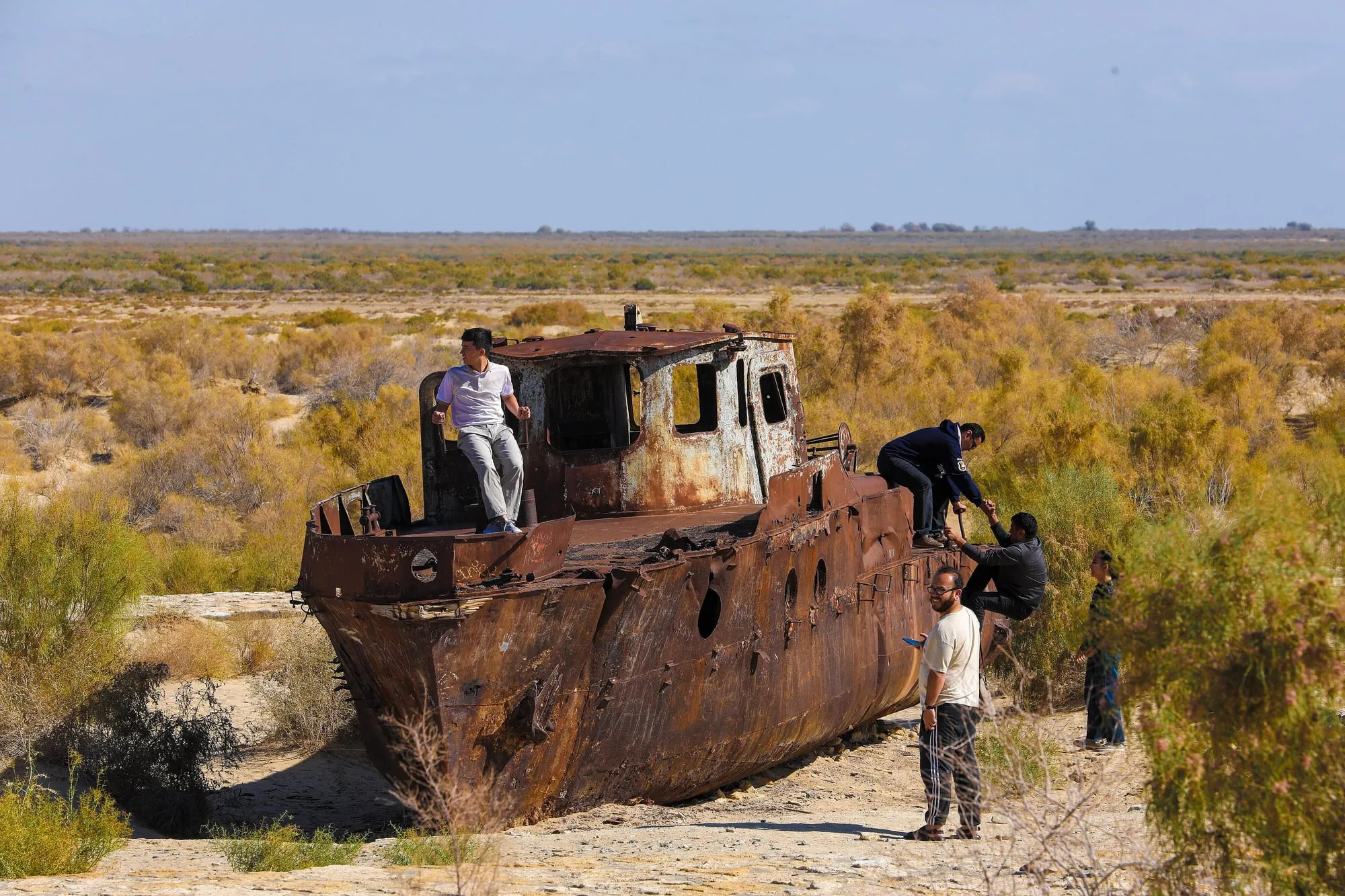
The regional tourism portal’s Uzbek description locates the ship museum on the site of Muynak’s former port. The fishing vessels and barges are on the exposed seabed. A booking that says “Muynak” or “Aral Sea region” does not, by itself, include a journey to the water. Ask for the actual endpoint and sleeping location.
NASA’s 2000–2018 satellite account links the Aral’s decline to Soviet-era diversion of the Amu Darya and Syr Darya for irrigation. It distinguishes the North and South Aral and records the South Aral’s eastern basin drying out in 2014. That event did not mean every part of the sea disappeared. Recovery in Kazakhstan’s North Aral does not describe the shore reached from Uzbekistan.
This trip suits a traveler interested in environmental history, Karakalpak culture and a substantial road journey. If your main wish is a photograph of the stranded ships, choose the Muynak version. An overnight stay by the shore adds vehicle time, a change of accommodation and dependence on the confirmed route and camp.
02
How many days and nights should you allow?
Start with the time you can spend after arriving in Nukus. We recommend one day trip to Muynak or two full days on the road for an overnight stay by the shore. Add a separate Nukus day if the Savitsky Museum is a priority. The allocations below are editorial planning choices; the driver must confirm the actual route for your dates.
| Your priority | Suggested allocation from Nukus | What this version leaves out |
|---|---|---|
| Nukus and its museums | A city day, with arrival and departure arranged around it | Muynak’s ships and the remaining shore |
| Muynak’s ships and local history | One road outing; return to Nukus | A visit to the remaining shoreline |
| Remaining shore and an overnight outside town | Two full road days and one confirmed overnight stay near the shore | A full Nukus museum day |
| More stops or a more relaxed driving schedule | Request a three-day route with two named overnight locations | The extra day is useful only if the written itinerary shows what changes |
03
What should a Muynak day trip include?
Build the Muynak outing around the ship cemetery, a museum visit and a meal break. Agree the pickup and return locations in Nukus, the museum you mean and how long you want at each stop. Keep the onward departure separate unless the driver has assessed the particular connection and you accept the consequences of a delay.
The Muynak Ecology Museum’s collection includes fishing equipment, historical photographs and everyday objects. The regional portal also identifies Aral paintings by Rafael Matevosyan and Faim Madgazin from the 1960s and 1970s. These offer a way to connect the ships outside with the working port and the people who lived around it. Confirm which exhibition is open, where to enter and the admission charge for your date.
Ask how visitors reach the ships from the vehicle and whether steps or uneven ground are involved. A viewing stop and a walk among the vessels require different amounts of time and mobility. Describe any access needs when arranging the car; “easy sightseeing” is too vague to settle that question.
In Nukus, the Savitsky Museum brings together fine art, Karakalpak applied art and material from ancient Khorezm. Set aside time for a separate visit if those collections matter to you. Confirm current galleries and opening arrangements before making the museum the last stop between a long drive and a flight.
04
What changes when the trip continues to the shore?
A published AyimTour route uses two days and one night, starting in Nukus and including Muynak, the former seabed, the Ustyurt Plateau and a yurt stay near the sea. It specifies a 4WD vehicle and says the order may change with conditions. This establishes a real route format; it does not confirm a departure, camp reservation or present journey time.
For a two-day version, protect the main purpose of each day. On the outward day, allow for the agreed Muynak visit and the drive onward to the sleeping location. On the return day, establish when you leave camp and where the journey ends before adding detours. A longer attraction list is only useful if the driver has allowed time for visits, breaks and the road.
Ask the operator to break the route into segments rather than quote one total. The road into Muynak and the onward section across the former seabed need separate discussion. A camp pin alone also does not tell you how you will reach the water from the camp.
- Nukus → Muynak: exact pickup, intended stops, driving estimate and meal break.
- Muynak → shore-area camp: chosen route, vehicle or driver change, current conditions and planned arrival before darkness.
- Camp → water: current destination, walking or driving, surface and assistance needed.
- Camp → Nukus or Khiva: departure, optional stops, estimated arrival and who confirms any onward connection.
05
Arrange the arrival, vehicle and guide together
Confirm how you will reach Nukus before fixing a morning road departure. Compare the actual arrival date and time, baggage collection or station exit, transfer to your hotel and the rest you need. Our train booking guide explains how to check an issued rail ticket; the Tashkent airport guide covers the first arrival if your trip begins there.
If starting or ending in Khiva, ask for a separate itinerary with the hotel endpoints written out. The price and daily schedule for a loop from Nukus do not automatically apply to a Khiva pickup or drop-off. Keep enough time for Khiva itself: arrival after a road day does not replace a full day in Ichan-Kala.
For a shore route, our recommendation is a driver experienced on the agreed tracks and a vehicle chosen for those conditions. Confirm passenger seats, seat belts, luggage space, air conditioning, fuel planning, spare equipment and the response to a breakdown. Include the guide in the seat count. Ask who actually provides each part if vehicles change in Muynak.
Specify the guiding language and whether the price includes interpretation at the museums and along the route. A driver and an English- or Russian-speaking guide are different services. For self-drive, obtain the rental provider’s written approval for the exact off-road sections and check recovery arrangements before committing. A road map and a car reservation are insufficient preparation for the onward desert leg.
Ask the organizer to check any access restrictions and document requirements for the exact route, including optional detours, and explain who arranges them and by when. Keep your passport and accommodation records available. This guide does not establish a universal permit requirement or a list of checkpoints.
06
Confirm the camp as carefully as the route
Get the camp name, current map location, overnight date and host contact in writing. Ask the person arranging the journey to reconfirm that the host expects your group. “Yurt accommodation” describes the sleeping structure; it does not establish the location, facilities or who else shares it.
A camp in or near Muynak can be suitable for a town stay. It does not become a shoreline overnight because the booking mentions the Aral. Ask for a current description of the camp-to-water journey and what happens if that part is inaccessible.
Tell the host about dietary and mobility needs before paying. If a particular toilet arrangement, bed or heating provision is essential, make it a booking condition rather than a request on arrival.
- Private or shared yurt; how many people; beds or floor mattresses; bedding and additional blankets.
- Toilet type and distance from the sleeping space; wash water, shower and hot-water arrangements.
- Lighting, charging times and power source; heating or cooling provision for your dates.
- Exactly which meals and drinking water are included, and where the group eats on each road day.
- How the host and driver communicate if mobile service is unavailable; who your contact in Nukus will be.
- Cancellation terms and the alternative accommodation if the camp or route cannot be used.
07
How to compare the full trip price
Request an itemized quote for the same dates, route, group and overnight conditions. Compare the total you would actually pay, then divide shared vehicle costs by the confirmed passengers. A cheaper per-person figure may assume a larger group, shared sleeping space or no guide.
AyimTour’s shared-trip information separates driver and guide arrangements and links prices to group size. Its online departure list is a place to inquire, not confirmation of seats. Before joining any shared car, ask whether departure is confirmed, who bears the cost if another traveler cancels and whether the agreed price can increase.
No dated quote for your particular journey is available on this page. Use the table to obtain one with the currency, payment method, validity date and exclusions stated. For payment preparation, see the Uzbekistan money guide.
| Quote item | Unit to confirm | What to settle |
|---|---|---|
| Vehicle and driver | Per vehicle, per day or complete route | Passenger and guide seats, fuel, driver’s accommodation, all endpoints and detours |
| Guide | Per day or complete trip | Language, number of days, museum guiding and a seat in the vehicle |
| Overnight | Per person, per yurt or room | Exact location and date, sharing, bedding, toilets and washing |
| Meals and drinking water | Per person or included | Named meals, road-day stops, dietary requests and supply arrangements |
| Museum and site visits | Per person and site | Which entries are included and who pays any separate charge |
| Changes and onward travel | Whole booking | Deposit, balance, cancellation, route fallback and extra transfer charges |
08
Choose dates around comfort and current conditions
Spring and autumn are sensible starting points for date discussions, but a countrywide “best season” does not settle conditions on a particular shore route. Use our season comparison to choose a travel month, then check Uzhydromet’s current information and the driver’s recent route assessment close to departure.
UNDP’s Uzbek account of seabed restoration describes saline ground, extreme temperatures and windblown sand as challenges in the area. For your journey, ask about daytime exposure, overnight bedding and any weather that would change the route. Do not use a forecast for central Nukus as the whole assessment for a remote camp.
Pack closed shoes for the agreed walks, sun protection, a warm layer, personal essentials and a charged power bank. Keep drinking water accessible in the vehicle and agree resupply before departure. Save the route, accommodation details and contact numbers offline. Our SIM and eSIM guide helps with service in Uzbekistan; a data package does not guarantee coverage at your camp.
Share your route and expected return with a contact, and agree when the driver will check in. If work calls or a time-critical departure cannot move, choose a town-based visit or change the schedule. Long periods in a vehicle, uncertain connectivity and accommodation that needs explicit facility checks are practical reasons to keep the shorter option.
09
Understand the place beyond the stranded ships
UNDP reports planting 80,000 saxaul seedlings on 80 hectares of exposed seabed in Muynak district in March 2025. The documented project concerns stabilizing and restoring the affected land. It is not evidence that the former sea has returned or that a visitor can join planting on any date they choose.
Karakalpakstan also has present-day livelihoods and institutions. A UNDP call published on 3 July 2026 sought community business proposals tied to land, wetlands and climate resilience in the Aral basin. An excursion should leave room for that context, rather than treating residents as part of an abandoned landscape.
Ask before photographing people or entering private spaces. Agree and pay for a hosted meal or demonstration; do not assume that it comes with a drive through a settlement. Follow your guide’s instructions near cliffs and fragile surfaces, leave museum objects and ship fragments in place, and take your rubbish back to an agreed disposal point.
If you want an environmental contribution to be part of the trip, ask for the organization, exact activity, permission and use of the payment. Buying a tour does not by itself establish a conservation outcome.
10
Fit the Aral into the whole Uzbekistan itinerary
Set aside time for the region before you allocate every day to the main cities. The example above uses arrival and departure days around two full days on the road; a separate Nukus museum day adds another day and, if the rest stays the same, another night. Put those dates on the same calendar as your international flights.
The 14-day Uzbekistan itinerary already assigns time to its city route. Adding an Aral shoreline trip means extending the journey or deliberately removing other stays and recalculating transfers. A Muynak day outing is a smaller commitment, but it still needs travel to and from Nukus.
To discuss whether this extension fits, send OxusRoad your travel dates, group size, arrival and departure points, and whether you want the ships, the remaining shore or both. Add your guiding language and essential sleeping or access requirements. Route, vehicle, host and price need confirmation for the actual request.
Common questions
Can I see the Aral Sea on a day trip from Nukus?
A Muynak day outing can cover the former port’s ships and local history, subject to the agreed schedule. It does not automatically reach the remaining water. If the shore is the purpose, request a route that names the current destination; our starting recommendation is two full days on the road and a confirmed overnight stay.
Is a yurt near Muynak the same as a camp by the sea?
No. The place name, accommodation type and relationship to the water are separate details. Ask for the current camp location and whether getting to the shore involves a drive or a walk. Confirm the host and the overnight date.
Can I visit the ship cemetery without booking a trip to the shore?
Yes: plan the Muynak visit as its own outing, with transport, museum arrangements and return agreed separately. Seeing the ships does not require adding the onward shore leg to your itinerary. Check the visitor arrangements and any charges for the date.
Will sharing a vehicle make the trip cheaper?
It can spread a vehicle charge across more travelers, but compare the confirmed total and inclusions. The guide also needs a seat, and shared accommodation may be a separate choice. Get the cancellation and repricing terms if another passenger drops out.
Should I fly or take a train straight after returning from the shore?
Our preferred plan includes a Nukus night after the return, then onward travel the next day. This is our recommended buffer, not a guaranteed minimum connection time. If considering a same-day departure, give the operator the actual ticket details and agree both the timing and the fallback before booking.
Sources and checks
Online sources checked on 13 September 2026. Uzbek museum, regional tourism and UNDP material supplies the local context; NASA and operator pages fill specific gaps. No field visit, road timing, camp reservation, price quote or route-permission check is claimed. Reconfirm the itinerary and services for your dates.
- Karakalpakstan tourism: Muynak ship museum
Text in Uzbek. Former-port location and fishing vessels; no present shore distance or ship count adopted.
- Karakalpakstan tourism: Muynak Ecology Museum
Uzbek. Collection context; current galleries, opening and charges require confirmation.
- Karakalpakstan tourism: Savitsky Museum
Uzbek. Nukus location and collection themes, not current exhibition access.
- NASA: shrinking Aral Sea
English. Historical satellite series through 2018; basin distinctions, not a current navigation map.
- UNDP: Green Aral Sea
Uzbek. Documented March 2025 planting and environmental conditions; not a bookable visitor activity.
- UNDP: Aral basin community grants
Uzbek, 3 July 2026. Community and environmental project context.
- AyimTour: Aral Sea route
English operator description. Two-day 4WD format; no present booking, camp facility or journey-time verification.
- AyimTour: shared-trip information
English operator page with a 2026 list. Group travel and guide arrangements; prices and available seats not republished.
- Uzhydromet
Uzbek official entry point for current updates. No trip-date forecast reproduced.