

01
Two days or three: count the usable time
Choose two days if your priority is the old city. Choose three if the country palace matters, you want more time inside museums, or long breaks are part of your travel pace. These are proposed sightseeing days, not the number of dates shown on a hotel booking.
For example, arrive on Monday evening, visit on Tuesday and Wednesday, then leave on Thursday: three nights give two full days. Add Thursday for the palace and leave on Friday: four nights give three full days. An early arrival or late departure may reduce the nights, but only after the actual journey and room arrangements are known.
| Time available | Plan | What to leave out |
|---|---|---|
| Arrival afternoon + one full day | Lyabi-Hauz and the domes on arrival if time allows; select Poi-Kalyan and the Ark the next day | A complete western circuit and country excursion |
| Two full days | Central monuments on day 1; Ark and western group on day 2 | Sitorai Mohi-Khosa unless it replaces a city block |
| Three full days | The same two days, then palace plus one chosen stop | A rushed circuit of every outlying shrine |
02
Orient yourself with three groups
The Historic Centre of Bukhara joined the World Heritage List in 1993. For planning, divide it into a central walking route, a western group and separate outlying visits. The tourism board’s city routes name the individual monuments; the day split below is our recommendation.
The central route joins Lyabi-Hauz, Toqi Sarrofon, Toqi Telpakfurushon, the Ulugh Beg and Abdulaziz Khan madrasas, Toqi Zargaron and Poi-Kalyan. Start at the end nearer your accommodation and reverse the order if useful. This is the strongest part of the plan for moving on foot between visits.
Treat the Ark, Bolo-Hauz, Samanid Mausoleum and Chashma-Ayub as another group. A short car ride to its first stop can save walking from a hotel on the other side of the centre. Chor Minor is a separate eastern detour; the country palace and Naqshband complex need their own transport plan.
Save the hotel entrance and these places in a map before setting out. Walking times depend on the chosen lanes, crossings, heat and mobility; the route is not a surveyed step-free walk. If stairs or uneven surfaces are a problem, have the hotel or guide confirm the specific entrances and vehicle drop-off points.
03
Day 1: Lyabi-Hauz, the trading route and Poi-Kalyan
Keep this day within the central group. Visit interiors that interest you, pause for lunch, then continue toward Poi-Kalyan. The table gives a sequence rather than clock times; switch the blocks if a particular museum has restricted opening hours that day.
| Part of the day | Visit order | How to adjust |
|---|---|---|
| Morning | Lyabi-Hauz → Toqi Sarrofon → Magoki-Attori → Toqi Telpakfurushon | Choose the carpet display at Magoki-Attori if textiles interest you; otherwise continue the walk |
| Late morning or after lunch | Ulugh Beg and Abdulaziz Khan madrasas → Toqi Zargaron | Start with one museum; add the other if time allows |
| Later afternoon | Poi-Kalyan: square, minaret exterior and mosque visit if admission is available | Leave time for the mosque rather than attaching the Ark to an already long day |
| Evening | Return to the area around your hotel for dinner | Revisit a square if you wish; paid interior re-entry and evening access require separate checks |
04
What to look for along the central route
At Lyabi-Hauz, identify the buildings around the pool before walking on: Kukeldash madrasa, the Divanbegi madrasa and the Divanbegi khanqah, a building associated with Sufi gatherings. The tourism board describes 160 cells at Kukeldash. Looking at the ensemble as several different institutions makes the stop more useful than treating the pool as the whole attraction.
The museum’s published list identifies the carpet museum at Magoki-Attori, calligraphy at Ulugh Beg madrasa and woodcarving at Abdulaziz Khan madrasa. Choose by subject: textiles, writing or carved decoration. Confirm which exhibition rooms are open before buying admission; a building’s name on the walking route does not imply every room is included.
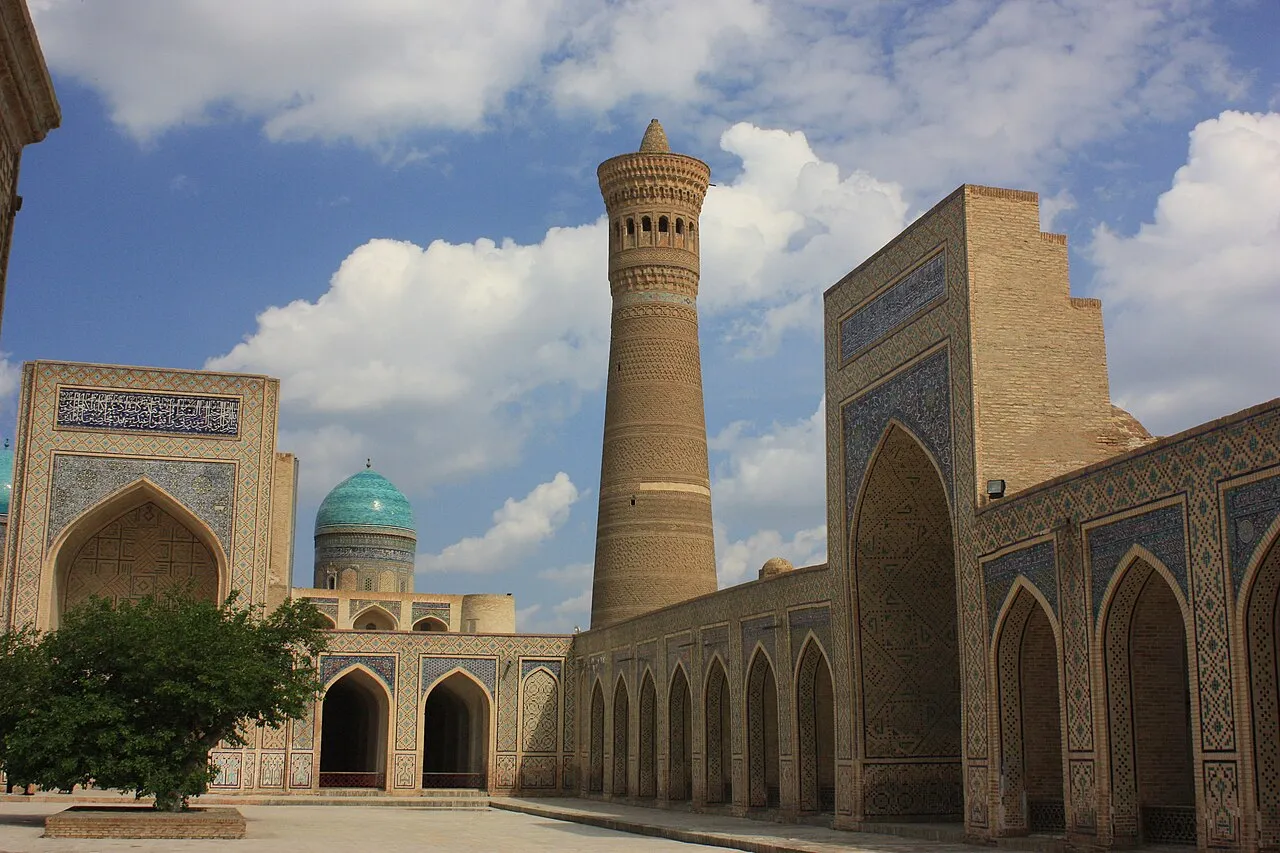
At Poi-Kalyan, the minaret dates to 1127, while the layout of the mosque and Mir-i-Arab madrasa visible today developed in the 16th century. These are different construction periods. Compare the minaret’s brickwork with the large mosque and the madrasa across the square. Treat a minaret climb or access inside the madrasa as a separate question for site staff, not an assumed part of the visit.
05
Day 2: the Ark and western Bukhara
Start with the Ark when its museum opens. The Bukhara State Museum-Reserve dates its founding to 1922 and its move into the citadel to 1945. Give its exhibits a substantial part of the morning rather than counting only a photograph of the entrance.
Continue to Bolo-Hauz, then choose the order of Chashma-Ayub and the Samanid Mausoleum according to the entrance in use and your energy. The tourism board groups these monuments together; walking or a short transfer between groups can be decided on the day. Keep lunch and a rest outside the museum time.
At the Samanid Mausoleum, look closely at how baked bricks form the decoration. The four sides have matching compositions beneath the dome. Walk around the exterior if access permits; the texture of the masonry is the reason to stop, rather than adding another blue-tiled facade to the day.
The museum at Chashma-Ayub is devoted to Bukhara’s water-supply history. It adds a different subject after the citadel and mausoleum. If you would rather focus on fewer places, drop this interior and preserve the rest break.
Chor Minor can fill a remaining late-afternoon block. The official Bukhara guide also names it Khalfa Niyazqul madrasa and gives 1807 as its opening year. Search both names when saving a map pin. If the western group has already used your day, move this detour to day 3 or omit it; it is not on the direct central route.
06
Day 3: the country palace, then one chosen visit
Use the additional day for Sitorai Mohi-Khosa, the country residence of Bukhara’s last emir. Uzbekistan Travel places it 4 km north of Bukhara; that description is not a measured distance from your hotel. Arrange a return ride or a driver with agreed waiting time. The new palace complex belongs to the early 20th century; the White Hall’s carved ganch plaster and mirrors give the visit a different focus from the madrasas.
Plan a half-day block including the journey and visit, then keep the second half flexible. This is an editorial allowance, not a measured tour duration. Before confirming transport, check which rooms and museum displays are included in the admission for your date.
| Your interest | One further stop | Planning consequence |
|---|---|---|
| Religious history | Bahauddin Naqshband memorial complex in Qasri Orifon | Ask for a route and return quote including both outlying stops; leave time for the site itself |
| Domestic architecture and everyday objects | The wealthy merchant’s house associated with Fayzulla Khojaev | Return to the city, have lunch, then visit the house museum |
| Photography, shopping or a gentler pace | Chor Minor, one missed interior, or a return to the old centre | No second outlying excursion; keep the remaining time for your priorities |
07
How the two extra visits differ
The Bahauddin Naqshband complex is in Qasri Orifon, Kogon district, at the burial place of the Sufi teacher associated with the Naqshbandi order. It is a pilgrimage destination. Agree the visit around current access and religious activity, follow the signs and staff’s instructions, and ask before photographing people at prayer.
The wealthy merchant’s house belonged to Ubaydullo Khoja, father of Fayzulla Khojaev, in the Gozion quarter. The museum describes decorated summer and winter rooms and displays about household life and trade. It suits a visitor who wants to understand a residence rather than add another large religious complex. Its Russian catalogue may appear even after you select the Uzbek site interface.
With only two full days, either extra can replace a city block. A palace morning instead of the western group means something has been cut; it does not turn a two-day plan into a three-day itinerary. Avoid combining the palace, Naqshband complex, house museum and a departing train in one nominally free afternoon.
08
Choose a hotel area by the walk you want
For this itinerary, accommodation near the old-city route reduces repeated journeys. Select an area first, then assess the particular property. The table describes geographic tradeoffs, not hotel rankings or verified room quality.
| Area to search | Why choose it | Confirm before booking |
|---|---|---|
| Lyabi-Hauz and nearby old-city lanes | Start day 1 near the pool and trading route; convenient for returning after dinner | Exact entrance pin, car access with luggage, room noise and stairs |
| Poi-Kalyan / trading-domes area | Reverse day 1 and begin near the minaret and madrasas | Distance from drop-off to reception; whether the room matches your access needs |
| Western side near the Ark | Begin day 2 near the citadel; useful if that is your main interest | Actual walking route back to Lyabi-Hauz and an agreed pickup point |
| Outside the historical core | Consider a specific hotel if its room or vehicle access better meets your needs | Add return transfers to each sightseeing day and compare the total cost |
09
Build in food, shade and a shorter version
In hot weather, put the main outdoor walking block early, return for a substantial lunch/rest break, and use the later part of the day for a second compact group. This is a pacing recommendation; the season guide explains the climate evidence and tradeoffs by month. Winter visits also need current opening checks rather than a summer evening schedule.
The Uzbek-language city guide names local dishes including halisa and qayish and describes Bukhara’s plov tradition. Use that as a starting point for a menu discussion. Ask what is available that day and explain dietary needs; a dish name does not establish its exact ingredients or portion size. Place lunch near the current sightseeing group rather than making a cross-city restaurant detour.
If you need a shorter plan, retain Lyabi-Hauz and Poi-Kalyan on day 1, then the Ark and Samanid Mausoleum on day 2. Other museum interiors become choices. With children or limited walking tolerance, make one major paid visit the morning anchor and decide the second block after the break.
At mosques and shrines, carry clothing that can cover shoulders and knees and follow the site’s entry and footwear instructions. Ask permission before close photographs of worshippers, residents or artisans. Visiting a shop is not permission to photograph its contents or a demonstration.
10
Admission, guides and the costs to confirm
Admission and guiding should be separate lines in your plan. The Museum-Reserve’s published tariff page distinguishes these services, but its stated effective date is 1 January 2025. We have not confirmed that price list as the current September 2026 tariff and therefore do not use it as a trip quote.
For each interior, ask for the current foreign-visitor admission, the child category if relevant, included rooms, last admission, re-entry and any photography fee. General opening hours in a website footer do not necessarily settle the last-entry time or which part of a complex is open.
For guiding, state the language, duration, meeting point and exact sites; ask whether admissions and transfers are included. For a car, give passenger and luggage counts, all stops, waiting time and final destination. Compare a price per vehicle with another price per vehicle, and calculate ticket costs per person.
Use the trip-cost worksheet for the combined budget and the money guide for payment preparation. OxusRoad can discuss a city guide, transfers or a Bukhara stay within a wider trip; dates and the agreed service list determine the actual quotation.
11
Arrival and the next city: protect the sightseeing days
The Biennial’s Uzbek visitor directions identify Buxoro-1 railway station in Kogon, outside Bukhara’s old-city sightseeing group. Save the exact station shown on your ticket, send your accommodation the train and arrival time, and agree how to reach the hotel. This source is a 2025 event page; its old train timings and shuttle arrangements are not a current timetable.
For arrival from Samarkand, reserve the actual dated journey and check its destination station using the train-booking guide. If your train reaches Kogon in the afternoon, count the remaining hotel transfer and check-in before deciding whether that is a sightseeing day. The Samarkand city plan helps allocate the preceding stop.
For onward travel, use the Bukhara–Khiva guide to compare the currently announced rail service with a road journey. Its weekday exceptions matter. A departure afternoon is not a full third sightseeing day, especially if you would first have to return from the country palace.
The 10-day itinerary places Bukhara within a four-city journey. The 14-day plan gives it three nights: an arrival day plus two full days before moving on. To secure three full Bukhara days, extend the stay or deliberately replace time elsewhere.
Common questions
Is two days enough for Bukhara?
Two full days can cover the central route and the Ark–Samanid group with breaks. An arrival afternoon plus the following day is a shorter visit. Add a third full day for the country palace and one further stop.
How many nights should I book?
For an evening arrival and morning departure, three nights give two full days; four nights give three. Earlier arrival or later departure can change that, but only after including the station journey, luggage and room access.
Can I walk everywhere in this plan?
The central route is planned around walking between monuments. The western group can start with a transfer, depending on your hotel and mobility. Arrange separate transport for Sitorai Mohi-Khosa and any onward visit to the Naqshband complex.
Should I choose the palace or another old-city museum?
Choose Sitorai Mohi-Khosa for a country residence and early-20th-century palace decoration. Choose the merchant’s house for domestic rooms and household history, or a central museum for a particular craft. With two days, substitute one for part of the plan.
Does this guide include current admission prices?
No. The museum’s online list is explicitly dated from January 2025, and a current tariff was not confirmed. Before visiting, check the foreign-visitor category, room access and any guiding or photography charges.
Sources and checks
Sources checked online on 13 September 2026. The route, day allocations, comparison of accommodation areas and visit choices are editorial recommendations based on the named places, not field-tested walking times. Most factual sources are in Uzbek; the merchant-house catalogue is Russian and UNESCO is English. Current admissions, room access, hotel quality, transport inventory and a guide assignment were not independently confirmed.
- Uzbekistan Travel — Bukhara
Uzbek. Chor Minor / Khalfa Niyazqul naming and 1807 date; food, craft and appropriate clothing for religious sites.
- Uzbekistan Travel — Lyabi-Hauz
Uzbek. Kukeldash, Divanbegi madrasa and khanqah; 160 cells at Kukeldash. No event timetable inferred.
- Uzbekistan Travel — Poi-Kalyan
Uzbek. Minaret dated 1127; present mosque and Mir-i-Arab ensemble associated with the 16th century.
- Uzbekistan Travel — Bukhara route inventory
Uzbek. Names of trading domes and central monuments only; the five-day tour and its timings are not our itinerary.
- Uzbekistan Travel — western city group
Uzbek. Ark, Bolo-Hauz, Samanid and Chashma-Ayub grouping; no current transport or opening times derived.
- Uzbekistan Travel — Samanid Mausoleum
Uzbek. Baked brick, patterned masonry, dome and matching sides. Legends and architectural superlatives omitted.
- Bukhara State Museum-Reserve
Uzbek institutional introduction: museum founded 1922, based in the Ark from 1945. Site includes Russian catalogue excerpts and ambiguous general hours.
- Museum-Reserve — published admission list
Uzbek Cyrillic. Effective date printed as 1 January 2025. Used for museum subjects and separate admission/guide service structure, not a confirmed September 2026 price quote.
- Uzbekistan Travel — Sitorai Mohi-Khosa
Uzbek. Country residence, location described as 4 km north of Bukhara, early-20th-century new complex and White Hall decoration. Distance is not a hotel route measurement.
- Uzbekistan Travel — Bahauddin Naqshband complex
Uzbek. Qasri Orifon in Kogon district, burial site and Naqshbandi pilgrimage context. No current access timetable verified.
- Museum-Reserve — wealthy merchant’s house
Russian article despite /uz/ URL. Ubaydullo Khoja house associated with Fayzulla Khojaev, Gozion quarter; decorated rooms, household and trade displays.
- Bukhara Biennial — 2025 visitor directions
Uzbek. Used only to identify Buxoro-1 railway station in Kogon. 2025 train times, fares, exhibitions and shuttles are not presented as current.
- UNESCO — Historic Centre of Bukhara
English. Inscribed in 1993; the listed property is the historic centre, not a separate inscription for every building.