

01
Two days, two nights or three nights?
This plan starts after breakfast with your luggage already at your accommodation. It assumes two days without a train or flight cutting into the sightseeing. The simplest arrangement is arrival evening → sightseeing day 1 → sightseeing day 2 → departure morning: three nights, two full days.
Two nights can work if you arrive early enough or leave late enough, but first subtract station transfers, luggage arrangements and boarding time. An afternoon arrival followed by a morning departure two nights later gives you one full day, plus whatever fits around those journeys.
Our 14-day Uzbekistan itinerary gives Samarkand three nights. If you are following the 10-day route, which assigns two nights here, use the shorter version below whenever the arrival and departure times leave less than two full days.
02
Understand the city before choosing a walking route
Use Registan as the central reference point. Gur-e Amir and Rukhobod are southwest of it; Bibi-Khanym is to the northeast, with Siyob Bazaar beside the mosque. Shah-i-Zinda lies farther east. These positions follow the official monument inventory; the day split below is our planning recommendation.
The practical walking groups are Gur-e Amir–Rukhobod–Registan, and Bibi-Khanym–Siyob. Shah-i-Zinda can join the second group, but check the actual pedestrian route and crossings before setting out. A straight line between map pins does not measure the walk from one entrance to another.
For Afrasiab Museum or Ulugh Beg Observatory, plan a separate outward and return journey. A taxi or arranged driver lets you keep that optional stop without turning every connection into sightseeing on foot. Save entrance pins and your accommodation address while you still have Wi-Fi.
03
The two-day plan, with time left for lunch and rest
Reserve a morning for Registan and keep the afternoon lighter. On the second day, begin at Shah-i-Zinda, then work back towards Bibi-Khanym and the bazaar. The durations below are suggested allowances inside each stop, not measured visits, entrance slots or transport times. Add walking, queues and meals separately.
| Day / part | Visit and suggested allowance | Movement or adjustment |
|---|---|---|
| 1 · Morning | Registan: 2–3 hours for the three madrasahs | Start after confirming access for your date; avoid adding another major stop before lunch |
| 1 · Midday | Lunch and a proper break | Return to your room if that gives you a useful rest; include the return journey |
| 1 · Afternoon | Gur-e Amir: 45–60 minutes; Rukhobod exterior if wanted | Walk the central link if comfortable, or use a taxi for one direction |
| 1 · Evening | Dinner; optional return to Registan | Check the dated evening note below and any separate admission conditions |
| 2 · Morning | Shah-i-Zinda: 60–90 minutes | Allow for the stairway and an unhurried visit to a place of pilgrimage |
| 2 · Late morning | Bibi-Khanym: 45–60 minutes; Siyob Bazaar: 30–45 minutes | Walk or take a vehicle from Shah-i-Zinda; the mosque and bazaar form one local group |
| 2 · Midday | Lunch and rest | Keep this break in hot weather; shorten the optional afternoon instead |
| 2 · Afternoon | Choose Afrasiab Museum or Ulugh Beg Observatory: 60–90 minutes | Add transport both ways; skip the extra stop if you prefer a slower core route |
04
Registan: treat the three madrasahs as separate visits
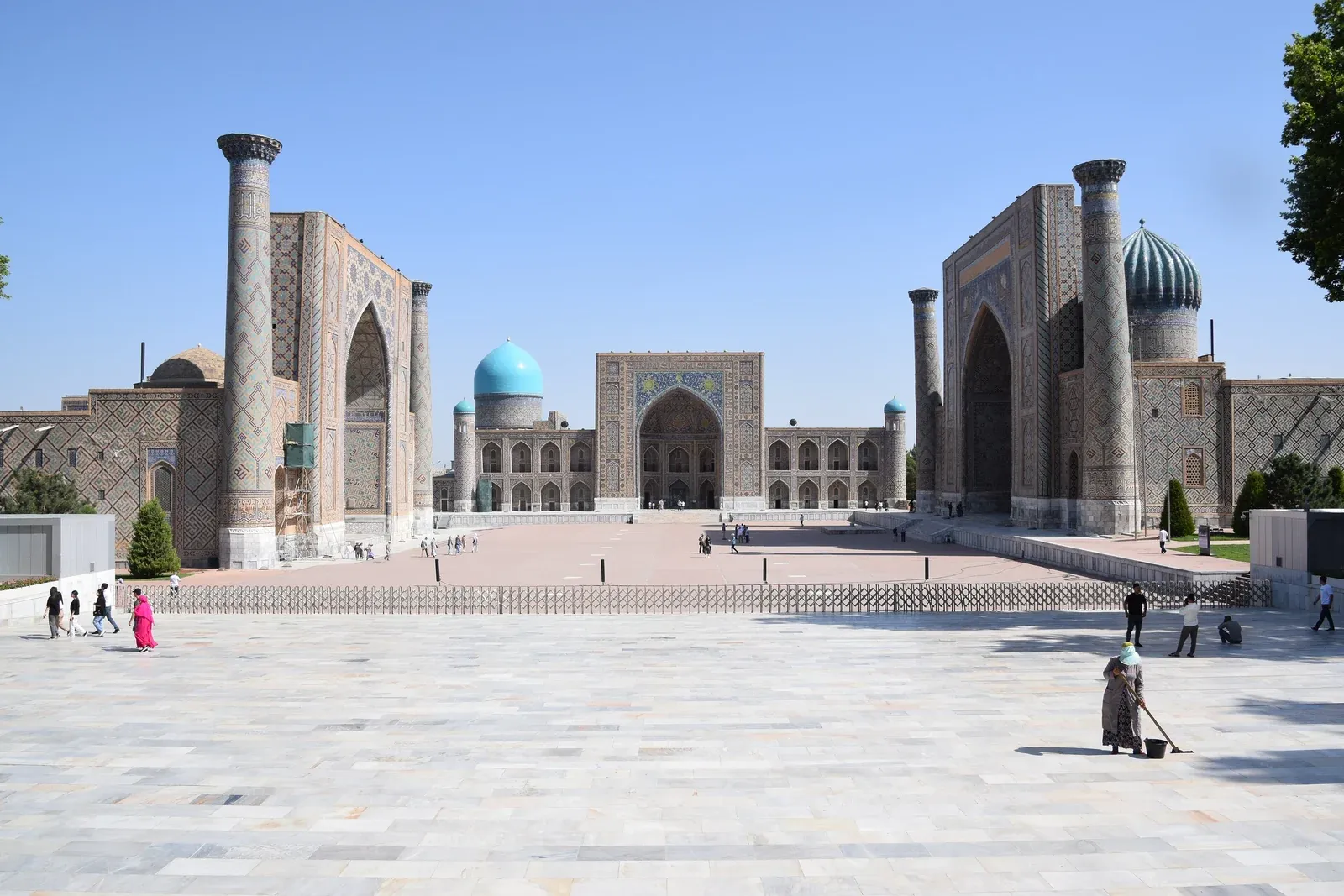
Registan consists of Ulugh Beg, Sher-Dor and Tilla-Qori madrasahs. Give each building part of your visit instead of spending the whole allowance on the view from the square. Seeing the ensemble first makes it easier to compare the buildings as you move through it.
Ulugh Beg Madrasah was built in 1417–1420. Sher-Dor, opposite, dates to 1619–1636; look for the animal-and-sun imagery on its portal. That two-century gap is a useful starting point for understanding why the square's buildings should not all be attributed to Timur's lifetime.
Tilla-Qori is also a seventeenth-century addition. The national tourism inventory dates its construction to 1646/47–1659/60. Keep time for it after the two facing madrasahs. If hiring a guide, ask for an explanation of the different building periods and inscriptions, with time to look independently afterwards.
The suggested two-to-three-hour block is an allocation, not a mandatory length of visit. If a building or room is unavailable on your date, use the time for the accessible parts rather than assuming a ticket guarantees every interior.
05
Gur-e Amir and the Rukhobod area
Gur-e Amir is a Timurid dynastic mausoleum where Timur's grave marker is made from dark nephrite. The official inventory lists it as the Amir Temur complex at Oqsaroy Street 1. Pairing it with Registan connects a funerary monument of the dynasty with buildings used for learning.
Rukhobod is a separate mausoleum on Oqsaroy Street, associated with Burhoniddin Sogharji. Include an exterior stop on the walk if you want another monument without adding a long transfer. An outside look and a paid interior visit are different choices; confirm entry conditions before extending the plan.
If you already visited Gur-e Amir after arriving the previous day, leave this afternoon free for a longer Registan visit or rest. There is no need to repeat the stop simply to preserve the order in the table.
06
Shah-i-Zinda: allow time for the stairway and the tilework
Shah-i-Zinda is a mausoleum ensemble and place of pilgrimage associated with Qusam ibn Abbas. The regional authority's Uzbek account describes three parts, an entrance gateway and a stairway leading into the next section. Do not assume a short distance on the map means the route is level.
The same account identifies Shodi Mulk Oqo's mausoleum, dated 1372, and distinguishes carved tile decoration used in the ensemble. Choose a few facades to examine closely: compare the shapes of the tile pieces, the lettering around entrances and the way decoration changes between buildings. This gives the visit a focus beyond taking the same corridor photograph at every doorway.
Our recommendation is to visit near the start of the day, after checking opening arrangements. Keep voices low around people praying, avoid blocking doorways for photographs and follow instructions on dress and access at the entrance. If stairs are difficult for your group, ask specifically about the route you could use and arrange assistance before committing to a guided visit.
07
Bibi-Khanym and Siyob Bazaar belong in the same outing
Bibi-Khanym Mosque was built on Timur's orders in 1399–1404. The complex includes the entrance, the main mosque and two smaller mosques. Use the courtyard to understand their relationship, then decide how much time you want for the parts currently accessible.
Siyob Bazaar is beside Bibi-Khanym. Uzbekistan's Samarkand city page identifies dried fruit, nuts, sweets, Samarkand bread and halva among the market's products. This is a practical point in the route to shop for a small quantity to try or to buy snacks before returning to your accommodation.
Ask the price and whether it is per piece, packet or kilogram before agreeing to a purchase. For lunch, choose a place that fits the next part of the route and your dietary requirements; leave time to sit down. This plan does not depend on a particular restaurant being open, a dish being available all day or every market stall accepting cards. See the money guide before relying on one payment method.
08
Afrasiab Museum or Ulugh Beg Observatory?
Choose Afrasiab for the city's history before the Timurid period; choose the observatory for the history of astronomy. The core second day already has three stops, so one additional museum is the default here. Visiting both is an option only after allowing time for transport and deciding which other activity to shorten.
Afrasiab Museum stands at the ancient city site. Its central display includes wall paintings from the palace of the Sogdian ruler Varkhuman. A 2024 official account dates the paintings to the seventh century and identifies envoys from Koguryo in one scene. Put the museum into your map search explicitly; the archaeological area and the museum entrance are not interchangeable destinations.
Ulugh Beg Observatory connects to the ruler whose madrasah you saw at Registan. The Uzbek tourism account dates its construction to 1428–1429 and describes the star catalogue containing 1,018 entries. Choose this stop if scientific instruments and the methods behind those measurements interest you.
Keep the museum choice out of your last hour before a train. If you need to return for luggage, the outward trip, visit, return and station journey are four separate parts to allow for.
09
Evening visits, opening hours and ticket checks
A Registan directorate announcement dated 9 September 2026 reports closing at 24:00 for Registan and Siyob, and 23:00 for Afrasiab Museum, Gur-e Amir, Bibi-Khanym and the Ulugh Beg museum complex. It also lists a daily musical show at Registan at 21:00. Times are local, UTC+5; checked online on 13 September 2026.
Use that dated announcement when asking about your evening, then confirm last admission, which interiors remain open and the ticket needed. The announcement does not specify a last-entry time, show duration, re-entry rights or whether the musical show is the 3D laser programme. A late closing time is not an instruction to start a full visit just before closing.
The Registan operator's website links to its official ticket service. We did not retrieve a current admission tariff in this check. Before paying, confirm the foreign-visitor category, included buildings, date validity and whether returning in the evening requires another ticket. Check the same items separately for the other sights; this guide does not assume a citywide combination ticket.
10
Where to stay for this particular route
Choose the address to suit the walks you intend to make. A hotel advertised as central can still be on the wrong side of your preferred daily route. The area choices below are editorial tradeoffs based on the monument locations, not hotel rankings or claims about room quality.
| Area to search | Why it fits | What to check |
|---|---|---|
| Around Registan | A useful base for the first day and an evening return to the square | Walking route from the entrance, vehicle pickup point and room noise; proximity alone does not settle these |
| Gur-e Amir / Rukhobod / Oqsaroy Street | Keeps the southern part of day 1 close to your room | The walk to Registan and the cost or effort of reaching the northeastern sights |
| Bibi-Khanym / Siyob side | Useful if the mosque and market are the part you want to revisit | The route to Shah-i-Zinda, crossings, and how you will reach Gur-e Amir |
| Near the railway station or another outlying address | Can suit a transport priority or a particular accommodation need | Price and time for repeated sightseeing journeys, not just the station pickup |
- Ask for the entrance pin, especially if the address opens onto a different street from the map label.
- Confirm luggage storage, check-in and check-out before using an arrival or departure day for sightseeing.
- If lifts, few steps or air-conditioning are essential, ask about the actual room and route to it. An area name cannot verify these features.
11
Adjust for heat, limited walking or only one full day
In hot weather, retain the early outdoor visit and midday break; remove the optional museum before removing the rest. A taxi can replace a connection, but it does not remove the walking and steps inside a monument. Our season guide helps you choose a month and pace without relying on a single daily forecast.
For one full day, choose Registan plus either Gur-e Amir or Shah-i-Zinda. Add Bibi-Khanym and Siyob only if you have an additional usable half-day. If astronomy or Sogdian history is your main interest, substitute the relevant museum for a monument; avoid simply attaching it to the end of a shortened day.
If you want a slower two days, keep day 1 as written and finish day 2 after Bibi-Khanym and lunch. Save Afrasiab and the observatory for another visit, or add a night. The two-day recommendation covers this selected city plan, not every attraction in Samarkand and its surroundings.
12
Arriving by train and continuing to Bukhara
Use the Tashkent–Samarkand train guide to compare the actual departures and stations. Plan the Samarkand station-to-hotel transfer separately from the train ride. Give a pickup driver the train number and arrival date, agree the meeting point, and save the hotel's entrance pin offline.
Before departure, work back from the train's boarding requirements and a current route estimate from your actual address. Keep time to collect luggage. A visit's suggested duration in the table excludes the station journey and does not establish a safe connection.
For the next city, use our Bukhara two-or-three-day plan and the train-booking guide. Confirm the available Samarkand–Bukhara service before fixing hotel dates or a guide appointment. The 10-day and 14-day routes show how these stays fit into a longer Uzbekistan trip.
OxusRoad can help arrange a Samarkand guide, station transfers or the wider trip. Send your dates, group size, arrival and departure details, preferred language and any walking limitations. Specify whether you want only selected services or an arranged itinerary; the independent-or-guided comparison can help you decide.
Common questions
Are two days enough for Samarkand?
Two full days suit the selected core plan: Registan, Gur-e Amir, Shah-i-Zinda, Bibi-Khanym and Siyob, with one optional museum. Two nights do not automatically provide two full days; check what remains after arrival, departure and luggage arrangements.
Can I walk between Samarkand's main sights?
Use walking for the central groups and assess the links separately. Gur-e Amir–Rukhobod–Registan and Bibi-Khanym–Siyob are useful groups; Shah-i-Zinda adds a stairway, while an optional museum outing needs its own transport plan. Check entrance-to-entrance routes for your pace.
What time is the Registan evening show?
The directorate's 9 September 2026 announcement lists a daily musical show at 21:00 local time. Confirm it for your date and ask about admission and the programme; the notice does not establish the timing or availability of a separate 3D laser show.
Should I choose Afrasiab Museum or Ulugh Beg Observatory?
Choose Afrasiab for Sogdian Samarkand and the palace wall paintings; choose Ulugh Beg Observatory for astronomy and the ruler's scientific work. The default two-day plan adds one, allowing transport and a midday break.
Do I need a guide for both days?
You can use the route independently and hire a guide for the part where explanation matters most to you, such as Registan or Shah-i-Zinda. Agree the language, places, visit length, transport and whether entrance tickets are included before confirming the service.
Sources and checks
Sources checked online on 13 September 2026, primarily in Uzbek. This is a proposed route based on published monument information and the dated operator announcement; it is not a field-tested walk or a booked tour. Visit allowances, day order, rest breaks and choice of accommodation area are editorial recommendations. No current ticket prices, last-entry times, hotel quotations or accessibility certification were established. Confirm those details for your dates.
- Uzbekistan Travel: Samarkand monument inventory
Uzbek; monument locations, names and historical dates.
- Uzbekistan Travel: Registan
Uzbek; identifies the three madrasahs.
- Uzbekistan Travel: Ulugh Beg Madrasah
Uzbek; construction in 1417–1420.
- Uzbekistan Travel: Sher-Dor
Uzbek; construction dates and portal imagery.
- Uzbekistan Travel: Gur-e Amir
Uzbek; dynastic mausoleum and nephrite grave marker. Legends not used as historical facts.
- Samarkand regional authority: Shah-i-Zinda
Uzbek in Cyrillic; ensemble layout, stairway and named mausoleums.
- Uzbekistan Travel: Bibi-Khanym
Uzbek; construction dates and parts of the mosque complex.
- Uzbekistan Travel: Samarkand city
Uzbek; Siyob's location and market products.
- Samarkand regional authority: Afrasiab Museum
Uzbek in Cyrillic; museum location and palace paintings. Old operating hours not used.
- Competition Committee: official Samarkand visit, 15 June 2024
Uzbek; seventh-century paintings and Koguryo envoys. A visit report, not an admission policy.
- Uzbekistan Travel: Ulugh Beg Observatory
Uzbek; observatory construction and 1,018-entry star catalogue.
- Registan directorate: evening-hours announcement, 9 September 2026
Uzbek; dated closing times and musical-show announcement.
- Registan directorate: official website
Uzbek page; links the operator's ticket service and contact details.
- Registan official ticket service
Linked by the directorate. No current tariff was retrieved during this check.