

01
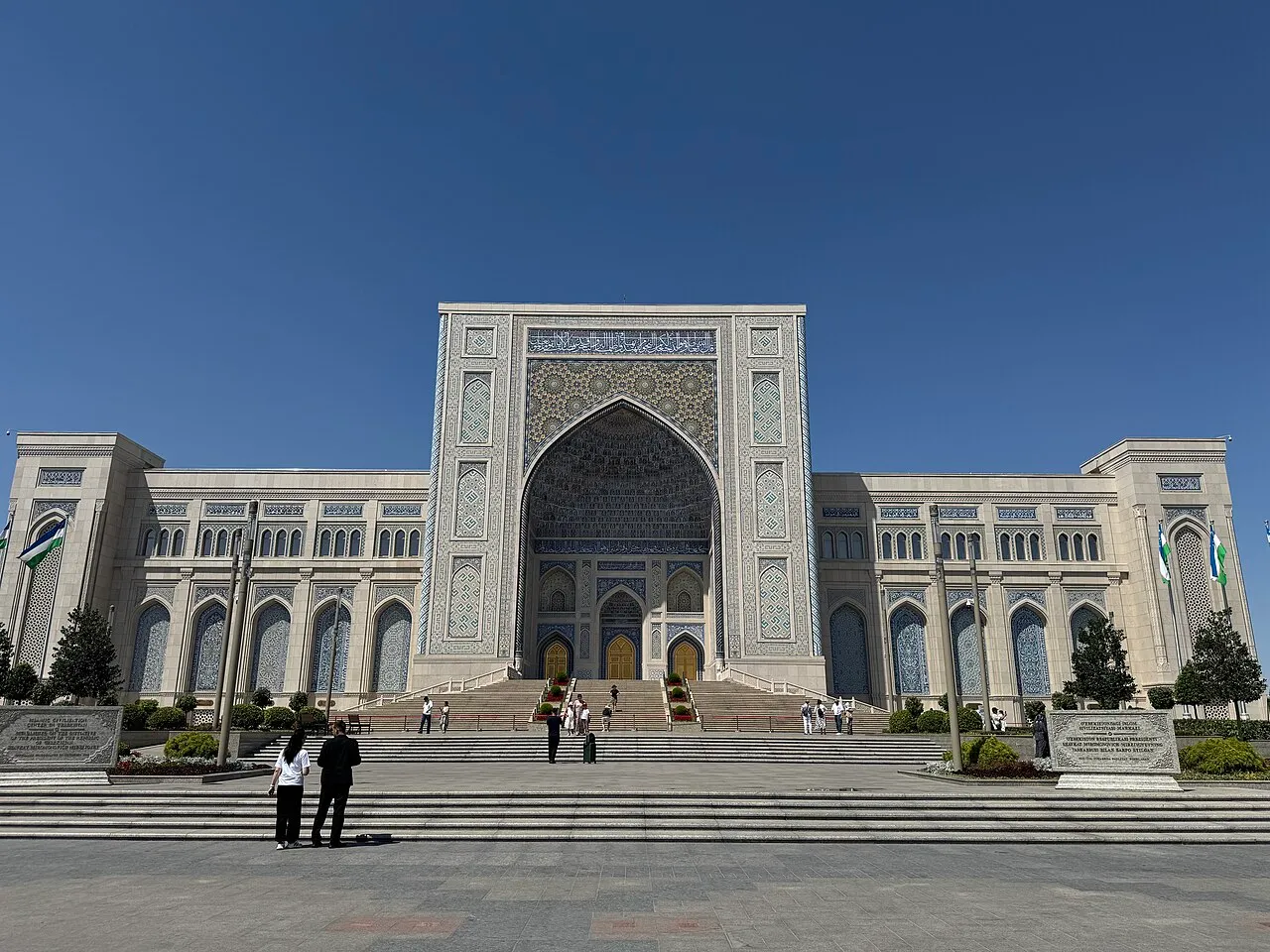
What is the Islamic Civilization Center?
The Center for Islamic Civilization in Uzbekistan brings together a museum, library and spaces for research and education. The Tourism Committee’s Uzbek overview describes a route through pre-Islamic culture, medieval scientific achievement, the Timurid period and modern Uzbekistan. Its central Quran Hall holds the Usman Mushaf, also called the Uthman or Othman Quran.
The project developed from an initiative announced in 2017. The official opening ceremony took place on 17 March 2026; older reports about construction or forthcoming admission belong to an earlier stage. The building is a modern addition to the Hazrati Imam area, so approach its exhibitions as a museum visit alongside the older religious ensemble.
On signs and maps, look for Islom sivilizatsiyasi markazi in Uzbek or Центр исламской цивилизации in Russian. For a driver, save the museum’s actual entrance pin. The wider names Khast Imam, Hast Imam and Hazrati Imam can lead to another part of the complex.
02
Who should make time for it?
Choose this museum if manuscripts, the history of science or Central Asian art are priorities. The Russian-language Afisha preview explains the museum’s broad cultural audience and describes a chronological exhibition that begins before Islam. You can follow the history through objects and interpretation without arriving with specialist religious knowledge.
Our recommendation is to make it the main indoor visit of your Tashkent day. For a first trip, the science and Timurid sections offer themes to follow later in Samarkand and Bukhara. If you mainly want a market walk and a brief look at historic courtyards, keep the shorter Tashkent city route.
There are real trade-offs: foreign admission is a substantial budget item, a timed session limits lingering, and multimedia forms a large part of the presentation. Someone wanting a quiet study of manuscripts should choose a longer visit and focus on the object labels. With only an arrival afternoon free, book after calculating the time left once luggage and hotel arrangements are complete.
03
What can you see in the galleries?
The center’s Uzbek exhibition overview identifies four main historical sections around the Quran Hall. Use these themes to decide where to spend attention. The table is our reading route, rather than a promise that every display or interactive feature will be available on your date.
The official English site names the halls differently from the four eras: its navigation lists a Hall of Honor, the Qur’an Hall, a Sogdiana Hall and a Tolerance Square, and it describes digital avatars of more than 100 scholars among the interactive displays. Use the hall names for wayfinding on site and the eras for deciding what to read.
| Section | What to look for | A useful question |
|---|---|---|
| Pre-Islamic civilizations | Archaeological material from Sogdiana, Bactria, Chach, Fergana and Khorezm | What do objects reveal about the region before Islam? |
| First Renaissance | Scientific instruments, manuscripts and the work of medieval scholars | How were knowledge and practical measurement connected? |
| Second Renaissance | Timurid miniatures, architectural decoration and Ulugh Beg’s astronomy | Which details connect with the monuments of Samarkand? |
| New Uzbekistan | The museum’s account of contemporary development | How does the institution connect its historical narrative to the present? |
04
Science, astronomy and Timurid art: choose a few objects
In the First Renaissance section, the center’s explanation of the science displays identifies a House of Wisdom installation associated with al-Khwarizmi and al-Farghani. It also describes a model nilometer, used to explain measuring the Nile’s water level, a qibla compass and a twelfth-century astrolabe. These are useful objects to follow if a long succession of scholars’ names feels abstract.
An effective way to approach the instruments is to ask what each measures and why someone needed the result. For the manuscript displays, compare the date of the text with the date of the copy on show. A work attributed to an early scholar and a manuscript copied centuries later are different historical objects.
The Ma’mun Academy installation introduces the scholarly circle in Khorezm associated with al-Biruni and Ibn Sina. The museum dates the academy’s activity to 1004–1017. Keep Khorezm in mind if your onward route includes Khiva; the historical region provides a wider frame than the walled city alone.
For the Timurid section, the center’s Russian report on a delegation’s visit names the Umar Aqta Quran and digital interpretations of Amir Temur and Gawharshad. Treat those digital figures as modern museum interpretation. If your interest is craftsmanship, spend more time comparing the manuscripts, miniatures and architectural decoration than watching every screen.
05
Where is the Usman Quran now?
The Usman Quran is in the Islamic Civilization Center’s Quran Hall, according to the Tourism Committee’s April 2026 account. Plan the current museum admission if this manuscript is the reason for your visit. An older reference to the manuscript library at Hazrati Imam does not establish today’s entrance or ticket.
The manuscript was inscribed in UNESCO’s Memory of the World register in 1997. That is recognition of documentary heritage. Use the manuscript’s museum label for its dating and history; this guide does not attempt to resolve differing historical claims about its origins.
Read the original/reproduction labels elsewhere in the hall, too. In a specific Russian-language object note, the center says the Uzbek Khan Quran on display is a replica and that the original remains in Turkey. The name of a famous manuscript on a gallery panel therefore does not by itself mean its original has been transferred to Tashkent.
Allow time to look at the writing and page design as well as the hall. Ask staff about photography before taking a picture of a manuscript; a general museum photo opportunity does not establish permission for every object.
06
How much do tickets cost?
These are the Uzbek iTicket rates checked on 15 September 2026. Standard admission includes an audio guide: Uzbek for the local category, English or Russian for the foreign category. A live guide is extra. The listing shows 6+ as the age restriction and says new session categories are released online after the last session on Sundays. Select the correct visitor category before comparing prices.
| Ticket or service | Local category | Foreign category |
|---|---|---|
| Standard adult + audio guide | 90,000 | 425,000 |
| Standard child + audio guide | 35,000 | 310,000 |
| Individual admission: stay until closing | 180,000 | 660,000 |
| Live guide, up to 10 people; admission extra | 300,000 | 480,000 |
| VIP: upper entrance + guide accompaniment | 350,000 | 850,000 |
| Fast Track, per group of 1–15: upper entrance, admission extra | 300,000 | 400,000 |
| Fast Track, per group of 16–30: upper entrance, admission extra | 500,000 | 600,000 |
| Children’s playground add-on, up to 1 hour | 30,000 | 180,000 |
07
Opening hours, visit length and booking
The official visitor page lists daily opening from 09:00 to 22:00, checked on 15 September 2026. Choose an available entry session on the linked ticket platform; closing time alone does not establish the final bookable session.
The ticket conditions describe a two-hour standard group visit; individual admission removes that limit until closing. Arrive 15–20 minutes early. Entry is allowed during the first 30 minutes of the booked session; the listing says tickets then lapse and are non-refundable. Re-entry is not allowed.
Our half-day allowance includes arrival, the museum session and a small amount of time nearby. It is a planning suggestion, not permission to remain beyond your ticket. For slower reading, compare individual admission before paying. The listing shows 6+ as the age restriction; it does not state what applies to younger children or which documents prove eligibility, so check both in the selected session.
Choose the date, visitor category and language, then review the total and terms. Save the QR ticket on your phone. For a group using a live guide, confirm the meeting point and whether the museum guide and your city guide are the same booking. Budget in UZS; see the money guide for payment preparation.
08
Where is it, and how do you get there?
The center’s official contact address is Qorasaroy Street 47, Olmazor district, Tashkent. The Uzbek Afisha venue listing uses 89A on the same street. Because these addresses differ, choose the center’s own linked map and confirm the visitor entrance when arranging your drop-off.
A taxi or prearranged driver to that entrance is the simplest planning choice when you have a fixed session. If combining public transport and walking, calculate the last leg to the museum itself. Chorsu station serves the market part of the old-city plan; do not treat arriving at the market as arriving at the museum.
Save the place name in both scripts and keep the return address available offline. We have not measured a step-free route from a metro station or verified lift access inside the museum. If stairs or walking distance matter, ask the center about the route from drop-off to the Quran Hall before buying: +998 71 227 15 48 or info@cisc.uz. Email is the practical channel if you do not speak Uzbek or Russian. The English version of the official site carries the same hours and address; its visitor-information page was empty on our 15 September 2026 check.
09
A half-day plan with Hazrati Imam and Chorsu
Use the booked museum session as the fixed point. The blocks below are our suggested allowances after leaving the museum; add travel between stops separately. On a hot day, shorten the outside stops. For an afternoon session, put the market earlier rather than assuming every stall will suit a late visit.
| Block | Plan | What to keep flexible |
|---|---|---|
| Before the session | Travel to the confirmed entrance and allow the recommended early arrival | Traffic and entry procedures |
| Museum | Follow your ticket duration; prioritize the Quran Hall and one historical theme | Time spent on individual displays |
| Hazrati Imam: 45–60 minutes | Choose accessible courtyards and one building of interest | Religious use and interior access |
| Chorsu: 60–90 minutes | Market browsing and a seated meal | Shopping, appetite and onward travel |
10
Clothing, children and the library
The published entry rules prohibit shorts and excessively revealing clothing. Choose clothing that meets that rule before leaving your hotel. Follow the instructions at each religious building you visit afterwards; museum admission does not determine mosque etiquette.
For a family visit, choose a few displays to discuss together instead of making every room compulsory. Ask children to find an instrument, compare two scripts or identify a pattern that appears again on a building outside. These are suggested activities, not an advertised children’s programme.
The library has its own arrangements. Its Uzbek opening announcement lists Monday–Friday 09:00–22:00, Saturday 09:00–18:00 and Sunday closed, and describes reader registration with an ID card. These hours, checked on 15 September 2026, differ from the museum’s daily schedule. Arrange library use separately if research is part of your visit.
11
Fit the museum into your Uzbekistan route
The 10-day itinerary places the museum on day 2; the 14-day route uses day 13 after returning to Tashkent, with day 2 as an alternative. On the seven-day trip, choose it only if a clear half-day remains after arrival and rest, replacing the shorter old-city programme. Confirm usable time before booking a session.
When asking OxusRoad to include the center in a trip, send your date, group size, children’s ages, preferred language and any mobility requirements. Specify whether you want audio-guided admission, a museum guide, transport or a full city day. Ask for the museum ticket and any guiding or transport to be itemized in the proposed plan.
Common questions
Is the Islamic Civilization Center open to visitors?
Yes. The official opening record is dated 17 March 2026, and the center links to public ticket sales. Check an available session for your date.
Is this the same visit as Hazrati Imam?
Plan them as separate stops in the same area: the modern museum has its own admission and timed visit. The Tashkent guide covers the wider old-city programme.
Can I visit without a live guide?
Yes. Compare standard audio-guided admission with the individual ticket if you want longer to read. If you do want a guide and are travelling alone, VIP is the cheaper route; from two people, standard tickets plus one shared guide service cost less. Confirm the selected category’s language and duration before payment.
Should I book on the day I land?
Only if arrival, luggage and the journey to the museum leave enough time for the session. A later Tashkent day is easier to plan when your flight arrival is uncertain.
Sources and checks
Sources checked online on 15 September 2026, starting with Uzbek-language material and then Russian-language sources. Ticket figures come from the current seller listing; older launch prices are excluded. Museum descriptions come from the institution and local reporting. Route choices and time allowances are editorial estimates. No onsite visit, ticket purchase or accessibility inspection is claimed.
- Presidential website: opening, 17 March 2026
Uzbek; opening date.
- Opening record in Russian
Russian; cross-check of the opening date.
- Tourism Committee: museum overview
Uzbek, 6 April 2026; scope and Quran Hall location.
- Center: Uzbek visitor information
Hours, address, contact and official booking link; checked 15 September 2026.
- Center: Russian visitor information
Russian cross-check of current daily opening hours.
- Center: English visitor information
English; hours, address, email, hall names and interactive displays. Marked as a test version; visitor-information page empty on 15 September 2026.
- iTicket: Uzbek ticket categories and rules
Current tariffs, visit duration and clothing rules; checked 15 September 2026.
- iTicket: Russian ticket categories and rules
Russian cross-check; no checkout or purchase performed.
- Center: four historical exhibition sections
Uzbek; gallery subjects and displayed material.
- Center: First Renaissance exhibits
Uzbek; House of Wisdom, nilometer model, compass and astrolabe.
- Center: Ma’mun Academy installation
Uzbek; scholarly context and 1004–1017 dates.
- Center: a visit to the Timurid galleries
Russian; named objects and digital interpretations.
- Center: Uzbek Khan Quran object note
Russian; explicitly distinguishes the displayed replica from the original in Turkey.
- Center: library opening and reader registration
Uzbek; separate hours and reader ID cards.
- UNESCO: Holy Koran Mushaf of Othman
English; Memory of the World registration in 1997 only.
- Afisha: Russian exhibition preview
12 March 2026; cultural scope. Pre-opening prices are superseded.
- Afisha: Uzbek venue listing
23 April 2026; 89A address differs from the institution’s 47. Not used for current prices.